
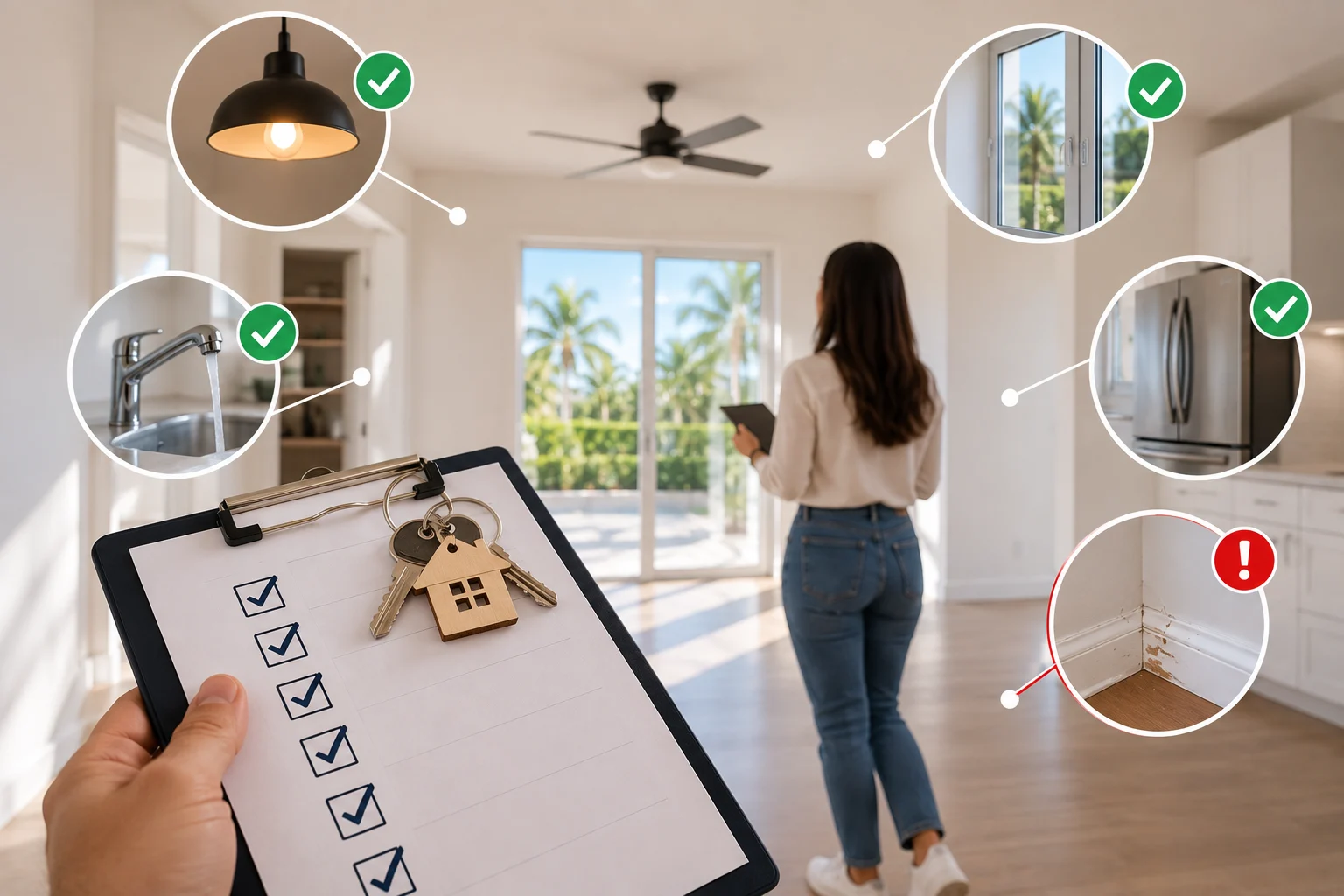
Confirm the home matches the condition you inspected, since that is your contractual right. Verify every negotiated repair with paperwork in hand, then run the air conditioning, water heater, and appliances. A failed unit costs $6,000 to $10,000 here. Anything genuinely wrong justifies a repair, a credit, or an escrow holdback, though only before you sign.
A Condition Check, Not a Second Inspection
Expectations matter here, since buyers who treat this as a re-inspection create friction over things they already accepted. On the Discover South Florida Podcast, Larry Mastropieri described the right scope.
"You and your realtor are going through arguably a watered-down checklist of inspection items."
Pace should stay brisk unless something genuinely warrants attention.
"You're usually not spending a ton of time there. You're not making it a big deal unless it needs to be made a big deal."
Start With the Repairs You Negotiated
Your first job involves verification of work the seller agreed to complete, and Larry lists the usual suspects.
"You're reviewing anything that was required to be done when you initially inspected the property and negotiated to move forward. That might be change an outlet or paint this wall or deal with some mold or termite thing."
Collect documentation instead of accepting a visual glance. Ask for invoices, warranties, and permits where the work required them, and confirm the contractor matches what the repair addendum specified. Buyers across Delray Beach and Boca Raton skip this step routinely.
Larry pushes to settle these well ahead of the date.
"Anything required to be repaired in a standard transaction during the inspection period that we negotiated, we try to get that done in advance too."
Which System Should You Test First?
One item deserves priority over everything else on your list, and the arithmetic explains why. Larry walks through the consequence of skipping it.
"Making sure the fridge works, making sure the AC is running, the basic important big items that you don't want to find out 24 hours later that you didn't check the AC."
The replacement number lands hard in this market.
"Now the AC tech comes out and you've got to replace the AC and now you're 6, 7, 8, 10 grand in the hole, which you could have prevented by just having checked that."
Run the system long enough to confirm it actually cools, since a unit that powers on can still fail to perform. Buyers across Palm Beach County should treat air conditioning as the single most expensive thing they can verify in five minutes.
What Changed Since You Last Saw It
Time passes between inspection and closing, and properties change during that window. Larry offers an example that catches buyers off guard.
"Maybe the grass was perfectly green when you were buying it, and then they didn't run the sprinkler system for three weeks and now all the grass is dead."
He attributes most of it to inattention instead of malice.
"I can go down the list of things that are a disaster that sellers do without thinking."
Look for anything that deteriorated while the house sat empty or during the move itself. Lawns, pool water, scraped walls, and torn screens all fall into this category.
Found something at the walkthrough and unsure how hard to push? Talk to a real estate agent near Boca Raton who has argued both sides of these and knows what a seller will actually concede on closing day. Reach out to The Mastropieri Group or call (561) 544-7000.
New Construction Deserves More Time
Builder purchases follow a different standard, and Larry treats them accordingly.
"When we sell new construction, the final walk could be more thorough. We've gone through iterations of blue tape exercises where we're taping up all the things the builder needs to address."
Early preparation keeps the closing day uneventful.
"Usually we try to get those things done in advance. So by the time we hit the day of closing, it's pretty certain we're not going to have a problem."
Schedule your punch list walk weeks ahead on a builder deal. A closing-day discovery leaves you negotiating with a company that closes homes on a production schedule. Buyers in Palm Beach Gardens and other new-construction corridors learn that quickly.
Schedule It Early Enough to Matter
Your scheduling shapes the available options more than thoroughness does. A walkthrough performed an hour before signing leaves you two choices, neither of them good. No contractor arrives that fast, and rescheduling a closing suits nobody.
Push for the day before whenever the seller has already moved out. That gap leaves room for a plumber, electrician, or air conditioning technician to visit beforehand, which converts a crisis into an errand.
Confirm three things when you schedule. The seller needs to be fully out, every utility must stay active, and each negotiated repair should already be complete with paperwork ready.
Document Everything as You Go
Your phone is the most useful tool you bring, and buyers underuse it badly. Photographs carry weight that a verbal complaint never will, particularly once a disagreement turns into a negotiation.
- Photograph each concern with a wide shot plus a close-up for context.
- Record short video of any system you tested, capturing the thermostat reading.
- Compare against your original inspection photos to prove what changed.
- Email findings to your agent immediately, creating a timestamped record.
- Keep every repair invoice, permit, and warranty the seller provided.
Send the package before you leave the property. A seller's agent receiving photographs while their client still holds the keys responds very differently than one receiving complaints an hour later.
Your Right Under the Contract
The standard is clearer than most buyers realize, and Larry states it precisely.
"You're supposed to receive the property in the condition by which you inspected it during your due diligence period. They're supposed to maintain that property in that condition."
Failure to do so is a contractual breach.
"If they haven't done that, they haven't performed according to the contract."
Ordinary wear and tear remains excepted from that standard. A carpet showing three more months of normal use gives you nothing. A dead lawn, a broken appliance, or an unrepaired item certainly can.
What Are Your Options if Something Is Wrong?
- Seller repairs the issue before closing, which works when time allows.
- Seller issues a closing credit, subject to lender approval on financed purchases.
- Funds get held in escrow after closing until the work finishes.
- The closing date moves later while the seller corrects the problem.
Larry frames the actual ask in plain terms.
"You can just say, hey, I'm not closing until you handle all this, or I'm not closing until you give me a credit."
A Credit Is Harder Than It Sounds
Financed buyers cannot simply adjust the number at the table. A seller credit requires a revised Closing Disclosure and lender sign-off, and title has to rework the figures before anyone signs.
The coordination alone consumes hours nobody budgeted for. That reality often pushes both sides toward cash exchanged outside closing, which carries its own complications worth discussing with your agent first.
How an Escrow Holdback Works
A holdback lets the closing proceed while the repair remains unfinished. The lender must approve the arrangement, and the held amount typically exceeds the estimated repair cost to cover overruns.
Written terms matter enormously on any holdback. Define who performs the work, the deadline, who inspects the result, and what happens to the money if nobody meets that deadline.
Why the Standoff Favors Nobody
Larry describes what happens once both parties dig in, and the honesty is useful.
"It becomes this staring contest. See who blinks first, see what you can get out of the seller. We've been in a lot of those, and it's just who's willing to eat their pride or bail first."
Personal circumstances drive most of these outcomes.
"Usually the buyer has movers showing up in two hours or they're homeless if they don't get this done today. And the sellers maybe are buying another home and they need this cash."
A Disputed Deposit Freezes for Months
The mechanics behind that pressure are worth understanding before you threaten anything. A buyer who refuses to close and demands their deposit back creates conflicting claims on that money.
Florida then imposes a notably slow process. A broker holding the funds must notify the Commission within 15 business days and begin a settlement procedure within 30. A disbursement order alone can take 60 to 120 days.
Realistic resolution runs two to four months, with the money sitting in a non-interest-bearing account throughout. Most disputes settle in mediation with both sides accepting a partial cut, which is precisely why neither party genuinely wants this fight. Buyers in Broward County should weigh that timeline against whatever they are arguing over.
The Line Between Enforcing and Extorting
Larry names an abuse that his own side of the transaction commits, which is unusual for a buyer's agent.
"Contracts are only as good as the two parties that signed them. If you want to be the tougher negotiator, you could just say, I'm not closing. I don't care what the contract says."
The tactic does succeed often enough to persist.
"If you act that way, sometimes the other party will acquiesce and just do the deal and give you what you've asked for. That's why I call it extortion, because many times buyers will extort a seller using that tactic."
His objection turns on whether a real problem exists.
"That's such a painful and not so nice tactic if it's not justified. If there's no legitimate issue, or the issue is very nominal or debatable, it's not a great tactic. It creates a very bad experience for everyone involved."
Ask yourself honestly which situation you occupy. A dead air conditioner justifies holding up a closing, while a smudge on a wall does not. Sellers in West Palm Beach remember which buyers played it straight.
Judging What Actually Deserves a Fight
Perspective saves deals, and a simple sorting exercise clarifies most findings. Compare the repair cost against what a delayed closing costs you in rate lock extensions, moving fees, and temporary housing.
Three tiers cover nearly everything you will encounter.
- Major items running four figures or more, including HVAC, roof leaks, and water heaters.
- Moderate issues in the hundreds, such as an appliance failure or dead landscaping.
- Minor cosmetic marks, which rarely justify anything beyond a mention.
Major findings warrant holding the closing without apology. Moderate ones usually settle with a quick conversation between agents. Minor ones cost you goodwill for no real return. Buyers in Broward County who chase every scuff mark find sellers digging in on things that genuinely mattered.
Options That Remain After Closing
A signature does not extinguish every remedy, though it narrows them considerably. A clear view of what survives helps you decide whether a small issue warrants a standoff.
A seller who knowingly concealed a material defect still faces exposure, since fraud claims survive the deed. Manufacturer warranties on newer appliances remain enforceable. Home warranty coverage may apply where the parties bought it, and builder warranties on new construction run for their stated terms.
Practical difficulty rises sharply, however. Any proof that a condition existed before closing grows far harder to assemble once you own the place. A photograph taken during the walkthrough therefore carries real value later.
Your Walkthrough Checklist
- Every negotiated repair, with invoices and permits in hand.
- Air conditioning, running long enough to confirm it actually cools.
- Water heater, confirmed by running hot taps at several fixtures.
- All appliances conveying, including a brief dishwasher and washer cycle.
- Every faucet and toilet, checking under sinks for fresh leaks.
- Electrical outlets, switches, ceiling fans, and exterior lighting.
- Garage door opener, gate remotes, mailbox keys, and alarm codes.
- Pool equipment running with clear water.
- Walls, floors, and screens for damage caused during the move.
- Lawn and irrigation condition, especially after a vacant stretch.
Photograph anything questionable and send it over immediately. A timestamped image sent before closing carries weight that a verbal complaint never will.
This page describes general practice under Florida residential contracts. Your specific agreement governs, and an attorney should review any dispute.
Five Minutes of Checking Beats a Year of Regret
Every walkthrough problem feels enormous the moment you spot it, and one phone call between agents resolves most of them. We walk the property beside you and say plainly whether a finding breaches the contract or simply irritates you. Then we press hard on whatever carries real money. Nobody should pay for an air conditioner they could have tested. Reach out to The Mastropieri Group, Realtors® at (561) 544-7000 and tell us what you found and we will tell you what it is worth.