
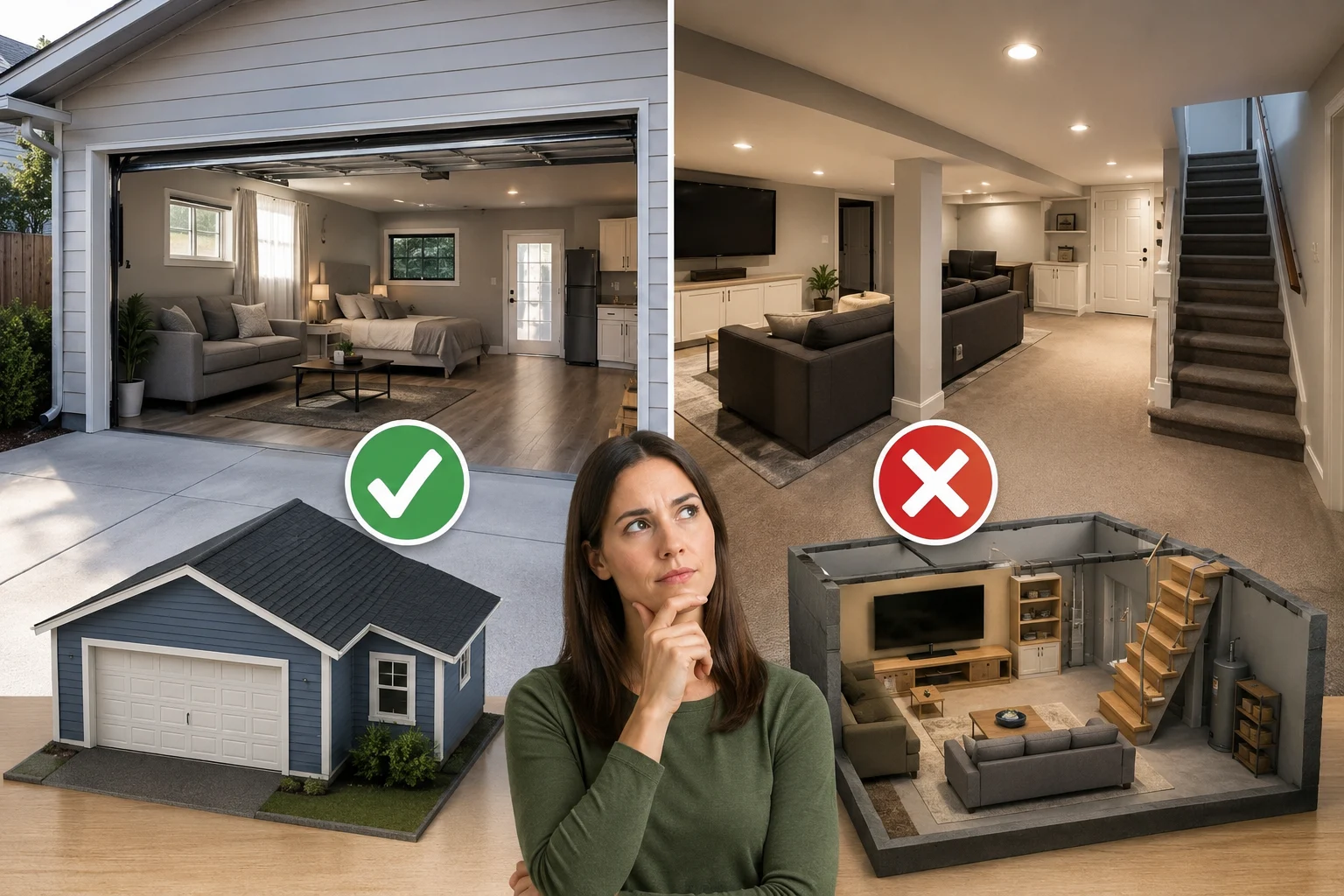
It depends on the property, the era it was built, the quality of the work, and what you plan to do with the home after purchase. A garage finished as living space on a 1960s home with no available records is a completely different situation than a recent renovation that intentionally skipped the building department.
Why the Answer Changes Based on the Property's Age, Location, and Intended Use
Undocumented modifications are not automatically a deal-breaker, and they are not automatically safe either. Roughly 40% to 50% of homes in the United States carry some form of work done without official approval, according to experienced agents surveyed by HomeLight. In South Florida, where homes from the 1960s and 1970s have been renovated multiple times over six decades, that percentage is likely even higher.
On the Discover South Florida Podcast, Larry Mastropieri laid out the framework he uses when evaluating these situations:
"People might have different opinions depending on the cities they're in, the states they're in, and the type of home you're buying. The answer is it depends on the property, the location, and what you want to do with it."
Three variables determine whether unpermitted work is a manageable risk or a genuine liability: the age of the home, the type of work that was done, and the buyer's plans after closing.
When Is an Unpermitted Garage Conversion on an Older Home Generally Acceptable?
Many South Florida homes built in the 1960s and 1970s carry decades of undocumented modifications. Florida rooms, enclosed patios, garage living spaces, new windows, and updated plumbing were common projects that homeowners handled without filing anything with the building department. Enforcement was lax, and digital tracking did not exist.
Larry explained the historical gap in permit records:
"We sell a lot of homes built in the 1970s. They have Florida rooms, this addition, that addition. None of this stuff is on permit record because they were done in the '60s, '70s, '80s, even the '90s. For 2000 and up, you start to see history tracked. But you can't always see a roof permit in 1980 or 1995."
A converted garage on a 1960s home with no available records is common in markets like Boca Raton, Delray Beach, and West Palm Beach. These modifications often predate any online tracking system. The absence of documentation does not necessarily mean the work was done poorly. It means the record-keeping era had not arrived yet.
Larry's guidance in these situations is straightforward:
"I don't have a problem buying something with a converted garage that's not permitted. It's fine. Just know what you're buying. With your inspector and your agent, you will uncover or determine if this was done well or not."
The key is inspection quality. A competent inspector evaluates whether the electrical work meets basic safety standards, whether the structural changes are sound, and whether the finished space creates any habitability concerns. If the work passes that scrutiny and the price reflects the home's true condition, an older garage modification without records is a manageable risk that most experienced buyers accept.
The Types of Unpermitted Work That Should Make a Buyer Walk Away
Not all unapproved modifications carry the same weight. A garage finished as a bedroom 40 years ago sits in a very different risk category than a roof replacement that bypassed the building department entirely. Larry drew a clear line between the two on the podcast.
Roof Work Done Without Permits Creates an Insurance and Financing Chain Reaction
Larry was direct about roofs being the one area where he treats undocumented work as a hard stop:
"If you're talking about a roof, that's a real hard one. That's kind of a hard no, unless you're getting paid for it. The roof issue is an insurance issue, and the insurance issue is a financing issue. You just go down the list."
In Florida, carriers require specific documentation before writing a homeowner's policy. A roof without records cannot be verified for age, materials, or code compliance. Without that verification, many carriers either deny coverage or write policies with exclusions. Without coverage, most lenders refuse to fund the loan, and the deal collapses before closing.
Even a cash buyer who sidesteps the financing requirement inherits the problem at resale. The next buyer's lender will flag the same issue, which narrows the pool of eligible purchasers and makes the home harder to sell.
Looking at a property in Palm Beach County or Broward County with modifications that may not have gone through the building department? We evaluate these situations property by property, pulling records, coordinating inspections, and explaining exactly how the work affects your coverage and loan options. Call The Mastropieri Group at (561) 544-7000.
The Pompano Beach Tiki Hut Story: How One Undocumented Structure Can Trigger a Chain of Violations
Larry shared a cautionary example from his team's experience. A buyer purchased a home in Pompano Beach with a tiki hut in the backyard that had never been filed with the city. The previous owner built it without going through the building department. The buyer planned to list the property on Airbnb, which in Pompano requires a formal city inspection.
"The inspector comes and checks to see what you've permitted or haven't. They call out the tiki hut. 'I don't see a permit here. You're in violation. Red tagged. We're not giving you the Airbnb permit.'"
The inspection did not stop there. Once the city found one violation, they looked for others.
"When they hit you with that, they probably hit you with some other stuff. They might hit you with a fence. 'Oh, this fence looks new. I don't see it was permitted.' That's nice."
A single undocumented structure triggered a cascade of violations that blocked the buyer's intended use of the property. The tiki hut, the fence, and the Airbnb application all became problems at once. That kind of domino effect is exactly what Larry warns buyers to anticipate when a property carries modifications that were never officially recorded.
How Does Unpermitted Work Affect Financing, Insurance, and Future Resale Value?
The financial impact of unapproved work extends well beyond the purchase price. Three areas create the most exposure for South Florida buyers.
- Appraisal limitations: square footage that was never officially recorded typically cannot be counted in the appraised value. A four-bedroom home with one unapproved bedroom appraises as a three-bedroom, which can reduce the valuation by tens of thousands and put the loan at risk.
- FHA and VA loan complications: government-backed loans enforce strict minimum property standards. Work done without building department approval often triggers a "subject-to" appraisal that halts the loan entirely. Conventional loans offer more flexibility but still flag significant modifications.
- Coverage claim denials: Florida carriers are increasingly rejecting claims that originate in areas where work bypassed the building department. If a fire or plumbing failure traces to a converted garage with no records, the carrier can argue negligence and decline the claim.
- Resale restrictions: the next buyer will encounter the same inspection, appraisal, and coverage challenges. Properties with documented unapproved work sell for $20,000 to $50,000 less than comparable homes with clean histories.
Why AI and Online Research Cannot Replace an Agent Walking the Property
Larry closed the podcast segment with a point that applies to every property carrying undocumented modifications. The evaluation requires physical presence, contextual judgment, and local construction knowledge that no database or search engine can replicate.
"You can't ask AI this question. It's not going to give you the boots on the ground, walking through the property. 'Oh, look at that seawall right there. That feels weird.' It's too subjective. It's just not something you can do with a blanket statement."
Larry's team brings a construction background that most agents lack entirely. They own 150 apartments, buy foreclosure properties regularly, and operate in the same neighborhoods where they help clients buy and sell. That hands-on experience with building systems, code compliance, and permit histories across Palm Beach Gardens and the broader South Florida market gives them an evaluative lens that goes beyond what any inspection report alone can offer.
Buyer Checklist: Evaluating a Home With Unapproved Modifications in South Florida
- Pull the full building department history through the county before making an offer. Compare what is on record against what you actually see in the home.
- Hire a licensed inspector who can evaluate the quality of the work and identify safety, electrical, and structural concerns independent of documentation status.
- Determine whether your loan type (FHA, VA, or conventional) allows flexibility around modifications that were not filed. Conventional loans are generally more forgiving.
- Obtain a coverage quote that specifically accounts for the converted space. Ask the carrier whether claims in that area would be honored or excluded.
- Negotiate a price reduction or seller credit equal to the estimated cost of retroactive approval, which can range from a few thousand dollars to significantly more depending on scope.
- Consider the resale implications. The same inspection, appraisal, and coverage challenges will surface again when you eventually sell.
Let Us Walk the Property and Tell You Exactly What the Modification Means
Every home with undocumented work tells a different story. A garage finished in 1975 and a garage finished last year without filing carry entirely different risk profiles, and the right decision depends on details that only a walkthrough, a record search, and local construction knowledge can reveal. We evaluate these situations deal by deal and give buyers a clear, honest assessment before they commit. Reach out to The Mastropieri Group, Realtors®. Call (561) 544-7000. Describe the property and we will tell you what to look out for before you tour it.