
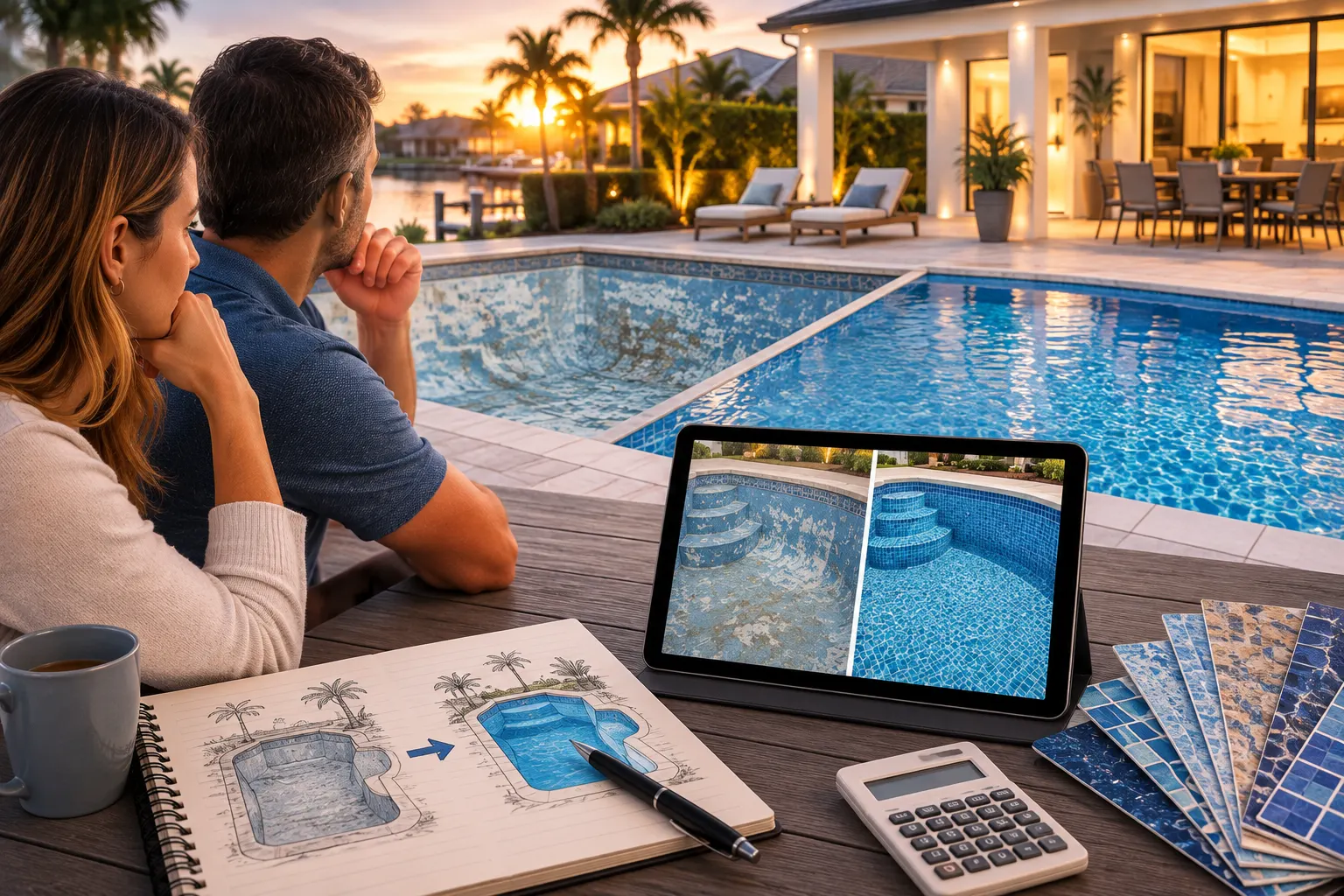
Identify your pool type first, since most South Florida homes have gunite with a diamond-brite finish and no liner whatsoever. A resurface on that shell runs $6,000 to $15,000 and returns roughly 60% to 80%. Spend there only when the house already shows well, and repair any active leak regardless, since unknowns cost sellers far more.
Most South Florida Pools Have No Liner
The question carries a premise that rarely applies in this market, and correcting it changes the whole conversation. On the Discover South Florida Podcast, Larry Mastropieri opened with that observation.
"This is not always applicable for South Florida. Most properties in South Florida are concrete gunite diamond-brited. That's usually what most pools are."
Vinyl liner pools remain uncommon here, largely because intense sun degrades liners faster than in northern climates. They also carry weaker resale perception locally, so builders and buyers gravitate toward gunite or fiberglass instead.
Larry knows the alternatives firsthand from his own acquisitions.
"Then you have the fiberglass pools, because again we bought a foreclosure and found out that it was a fiberglass pool."
His reaction to owning a liner pool is worth noting, since it inverts what most sellers assume.
"I would have been super pumped for a liner. You just put a new liner in."
What Each Pool Type Actually Needs
- Gunite and concrete shells last 50 years or more but need resurfacing every 10 to 15 years.
- Fiberglass shells run 25 years or longer and require no resurfacing at all.
- Vinyl liners need replacement every 5 to 15 years, and Florida sun shortens that window.
- Annual maintenance runs highest on gunite and lowest on fiberglass.
- A gunite resurface typically costs $6,000 to $15,000 depending on size.
- A liner replacement generally lands between $3,000 and $7,500.
Identify which type you own before pricing anything. Sellers throughout Palm Beach County often discover their pool needs resurfacing instead of a liner they never had.
The Three Questions That Decide Any Upgrade
Larry applies one framework to every improvement question, and pools receive no exception.
"This answer is going to be the same. I need to see the comps in the neighborhood. I need to understand what price we're trying to target. And then I need to understand what the home looks like in totality."
Those inputs come before any conversation about specific work.
"It all depends on the holistic view of the entire home plus the comps, before we start making decisions on should we change this vanity out, should we do this liner?"
The Fifty-Year Roof Test
His illustration explains when a single big-ticket repair genuinely earns its cost. The logic turns on how complete the rest of the property is.
"If the entire house is gutted to the studs, but you have a 50-year-old roof, which is exceeding its useful life in South Florida by a long shot, and everything else is perfect, then you do the roof."
The reasoning behind that call applies equally to a pool surface.
"You're selling a brand new house and you're just missing the roof. The return on investment there is going to be massive, versus the cost associated with not doing it is going to be massive too."
One glaring flaw in an otherwise finished home draws every eye and invites a deep discount. That same flaw in a house needing ten other things simply joins the list. Sellers in West Palm Beach see this pattern on renovated properties constantly.
Got a quote for pool work and no idea whether it pays off? Talk to a real estate agent near Boca Raton who prices pool condition against neighborhood comps every week and will tell you when to skip it. Reach out to The Mastropieri Group or call (561) 544-7000.
When the Rest of the House Undercuts the Spend
The reverse scenario produces the opposite recommendation, and Larry delivers it without hedging.
"If you don't have everything done and you're asking me do I do this pool liner, but the rest of the place is a complete disaster, then probably don't do it."
Buyers evaluating a property that needs substantial work price the whole package, not individual components. A resurfaced pool beside a failing roof and dated kitchen rarely moves the number. That buyer already filed the home under projects.
Two Reasons Worth Spending Money
Larry runs a foreclosure acquisition business, which forces this decision constantly. His default surprises people.
"In most cases we're not doing the full rehabs. We're just buying them and letting the next person do the work they want to do."
Only two situations change that calculus.
"The only reason we would do work in a specific property is one, convenience. Light, bright, open space, super clean. Those things kind of just optimize, because those are low dollar things."
The second reason involves genuine unsellability.
"Or there's some real major issue that's like, well, this thing's unsellable with the structural issue. We got to go fix this."
A pool liner or resurface rarely lands in either bucket. A pool that leaks badly enough to threaten the deck or the structure, though, moves squarely into the second category.
The Two Fundamentals Underneath It All
Everything else follows from two requirements, which Larry ranks above any cosmetic consideration.
"We can't sell a house that doesn't have a clear title. So our job first and foremost is buy property that we can clear the title on, and then buy property that we can sell to someone that is structurally sound."
Clear title and sound structure make a home sellable. Everything beyond those two is refinement, which only pays once the fundamentals hold.
The Basics That Always Pay
His low-dollar list costs a fraction of any pool work and moves buyers more reliably.
"Empty the house of all the junk that somebody left behind, make sure all the lights work, make sure the water's running, make sure it's deep cleaned. Just basic stuff. And that's where you leave it."
Apply the same standard outside. Clean decking, working equipment, clear water, and tidy plantings cost very little and shape the impression far more than a new surface would. Buyers touring Boca Raton homes spot a neglected pool long before they evaluate its finish.
What Does Pool Work Actually Return?
A resurface recovers roughly 60% to 80% of its cost at resale, which places it below the strongest interior projects. The indirect benefit matters as much as the direct return, since rough or stained surfaces create negative impressions that reduce offers and extend market time.
Deferred work compounds against you as well. Exposed aggregate or rebar creates sharp edges that make a pool unusable. Water escaping through surface cracks can undermine the shell and damage the surrounding deck, so a repair postponed long enough can double in cost. Owners in Broward County facing visible deterioration should weigh that trajectory before deciding to wait.
Why a Pool Inspection Is Worth Ordering First
Standard home inspectors give pools only a cursory look, which leaves both parties guessing about the expensive parts. A dedicated pool inspection costs a few hundred dollars and answers the questions that actually drive a negotiation.
The report covers shell condition, equipment age and function, plumbing pressure, electrical bonding, and whether the safety features meet code. Sellers who order one before listing gain something valuable, since a clean report handed to buyers removes the uncertainty that produces lowball offers. A report revealing problems gives you time to fix or price them on your own schedule.
Buyers benefit equally. A pool represents one of the largest single systems on any property. Several hundred dollars spent verifying it prevents a five-figure surprise after closing.
Cheap Fixes That Change the Impression
Several improvements cost very little while shifting how a pool photographs and shows, and they belong on every seller's list before anyone discusses resurfacing.
- Balance the chemistry so the water reads clear blue instead of cloudy or green.
- Pressure wash the deck and remove stains from pavers or concrete.
- Replace burned-out pool and garden lighting, especially for evening photos.
- Service the pump and filter so nothing rattles during a showing.
- Trim overhanging vegetation dropping debris into the water.
- Repair torn screen panels on an enclosure, which read as neglect from every angle.
Clear water photographs beautifully at almost any surface age. Cloudy water suggests the entire property has gone unmaintained, and buyers extend that assumption well past the pool deck.
What Buyers and Inspectors Flag First
- Any active leak, since the source and extent stay unknown until someone investigates.
- Pump, filter, and heater age, which buyers price as upcoming replacements.
- Rough, chalky, or heavily stained interior surfaces underfoot.
- Cracked or lifting deck material around the perimeter.
- Cloudy water or visible algae, which suggests neglected maintenance throughout.
- A missing or non-compliant safety barrier.
Leaks outrank everything on that list. An unexplained leak forces a buyer to imagine the worst case, which is exactly the uncertainty discount that costs sellers real money. Homeowners across Palm Beach Gardens should test before listing instead of after.
Florida's Pool Safety Requirement
State law imposes an obligation many owners overlook until a buyer's inspector raises it. Florida's Residential Swimming Pool Safety Act requires every home pool to carry at least one approved protective feature.
- An enclosure or barrier isolating the pool from the home that meets code requirements.
- An approved safety pool cover.
- Exit alarms on doors and windows providing direct access to the pool.
- Self-closing and self-latching devices on those access points.
Confirm your compliance before listing. A missing barrier can complicate insurance for your buyer and occasionally delays a closing while someone installs the fix.
Selling the Pool As-Is Instead
A price that reflects the condition remains a legitimate strategy, particularly when the house needs other work. Buyers shopping that category expect to invest, and many prefer choosing their own finish over inheriting yours.
Disclose what you know either way. A leak you were aware of and never mentioned creates exposure well past closing, while a documented condition priced honestly rarely produces a dispute. Sellers in Delray Beach often find transparency here costs less than the repair would have.
Disclosure Obligations Around Pool Problems
Florida sellers must disclose known defects that materially affect value and stay hidden from a reasonable inspection, and pool issues fit that description often. Any leak repaired twice, a crack covered during resurfacing, or equipment you know is failing all belong on the disclosure.
An as-is contract does not erase that duty. Sellers sometimes assume those words end the conversation, though the obligation to disclose known hidden problems survives regardless of contract language. A documented leak priced honestly costs far less than a concealed one discovered after closing.
How a Pool Affects Insurance for Your Buyer
Carriers treat pools as a liability exposure, and that reality reaches your transaction more often than sellers expect. Your buyer's premium will run higher, and some carriers require specific features before writing a policy at all.
A compliant safety barrier matters most here. Damaged or absent fencing can stall a policy, and a buyer unable to bind coverage cannot close on a financed purchase. Underwriters treat diving boards and slides as added exposure, and several carriers decline properties that have them. Owners across Broward County should confirm barrier compliance early, well before a lender's deadline forces the issue.
Pool Decision Checklist
- Identify your pool type before pricing any work.
- Test for leaks, since that single unknown affects buyers most.
- Confirm the safety barrier meets state requirements.
- Compare your plan against recently sold homes with comparable pools.
- Service the equipment and clear the water regardless of what else you decide.
- Price the condition honestly when the surface work does not pencil out.
Cost ranges reflect typical Florida pricing and vary by size and scope. A comparative market analysis gives you accurate expectations for your specific property.
Clear Water Sells Better Than a New Surface
Sellers reach for the expensive pool fix long before they exhaust the cheap ones, and buyers rarely notice the difference. We walk the property and weigh the pool against what sold nearby. That comparison separates the work that protects your price from the work that only spends your money. A service call and a clean deck carry most listings further than a resurface would. Reach out to The Mastropieri Group, Realtors® at (561) 544-7000 and describe the pool and the house, and we will tell you what actually needs doing.