
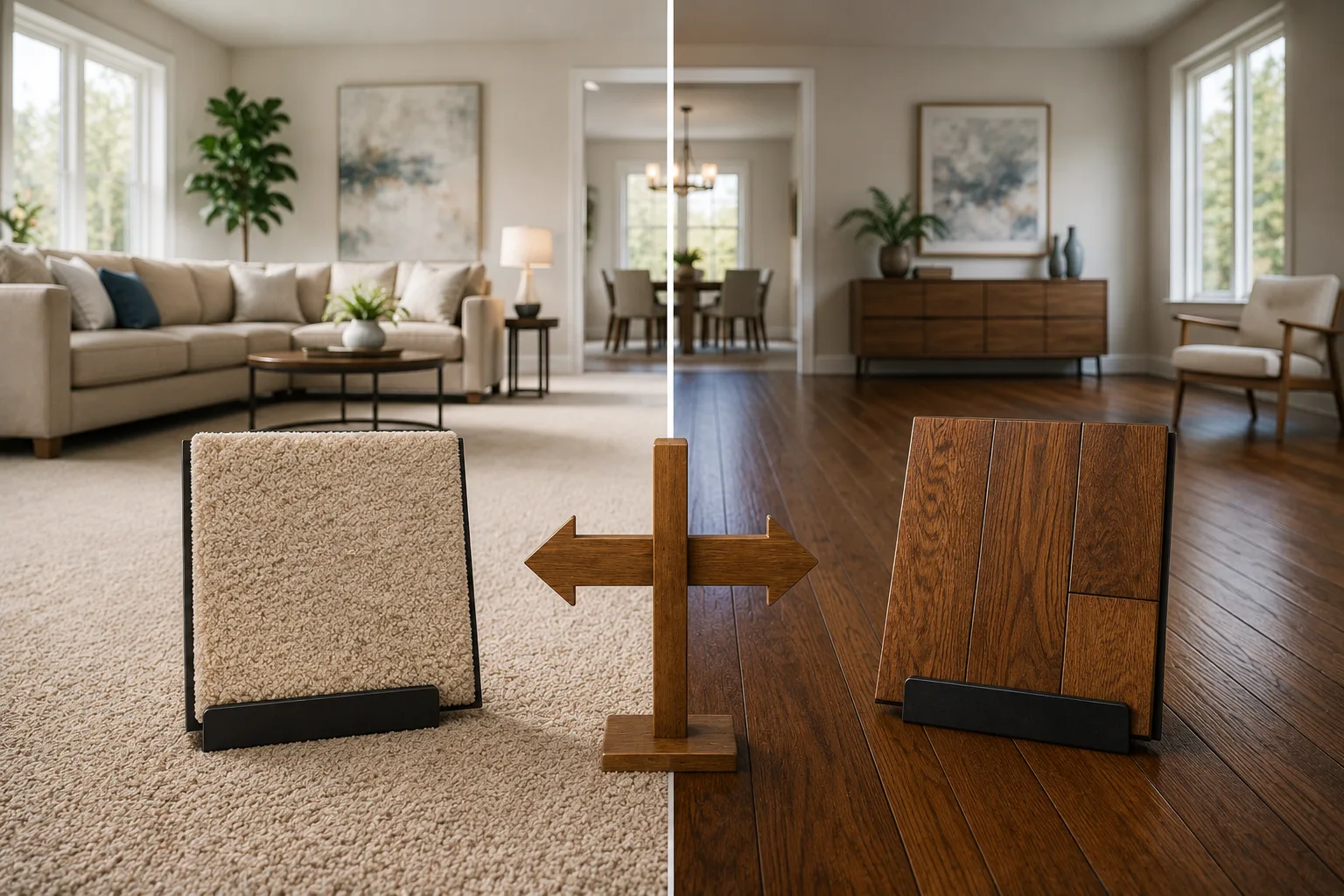
Check under the carpet first. Hardwood hiding there refinishes for a fraction of replacement cost and returns roughly 147%, more than any other interior project. Fresh carpet handles bedrooms cheaply when no wood exists. New hardwood installation returns only 70% to 80%, so reserve it for homes above $750,000 or floors you can genuinely match.
The Three Questions That Decide It
Any honest answer requires information about your specific property, and flooring is no exception. On the Discover South Florida Podcast, Larry Mastropieri laid out the framework he applies to every upgrade question.
"What do the comps in the neighborhood look like? What are we targeting price-wise? And what does the rest of the home look like?"
Those three inputs shape every recommendation that follows.
"You can ask me a thousand questions about what I should upgrade or what I shouldn't, but without me doing those three things, we can't have this discussion."
A flooring choice that works in a $350,000 townhome fits poorly in a $1.2 million waterfront home, and the reverse holds equally true.
Structural Problems Come Before Any Floor
Larry ranks repairs by how much uncertainty they remove, and that ordering puts flooring far down the list. Anything a buyer cannot price accurately costs a seller disproportionately.
"If there's a structural issue, the value you're going to get for doing that work is massive, because people are just going to be like, this is unknown. This could cost me a hundred grand or five grand."
The arithmetic behind that logic deserves attention.
"If the seller takes on that risk and says, okay, it cost me 15, great. The new buyer won't have that question. It'll be done, documented, and proven."
An unresolved problem invites the buyer to price the worst case.
"Well, it could cost me 100 grand. I'm not taking the risk. I don't know this house well enough. So I'm going to offer you a hundred grand less. You just saved $85,000 by doing this work as a seller."
The Pool Leak Principle
His example makes the concept concrete, and South Florida sellers meet this one constantly.
"A leak in a pool is a huge unknown. Where's the leak? How bad is the leak? What is the extent of the work that needs to be done?"
The governing rule follows from there.
"When there's massive uncertainty around cost associated with a project that must be done in order to just have a livable house, we probably should address it as the seller."
Sellers across Palm Beach County lose more to unpriced unknowns than to any cosmetic shortfall. Your floors belong to the second category, which is why they wait.
What the Flooring Numbers Actually Show
Return data separates these options more clearly than opinion does, and the spread is wide.
- A refinish on existing hardwood returns roughly 147%, the highest of any interior project.
- New hardwood installation returns approximately 70% to 80%, occasionally more in premium markets.
- Luxury vinyl plank returns about 65% to 80% at roughly half the cost of hardwood.
- Carpet consistently draws the lowest buyer appeal among flooring types.
- Solid hardwood can lift a sale price 2.5% to 5% when the market supports it.
Absolute dollars matter more than percentages here. A $5,000 vinyl installation returning 75% loses $1,250, while a $15,000 hardwood installation at the same percentage loses $3,750. The cheaper option risks less even when the return rate matches.
Refinish Before You Replace
Hardwood hiding under old carpet represents the best outcome available to a seller. A sand and refinish costs a fraction of new installation and returns more than you spend. Almost nothing else in a home can make that claim.
Pull back a corner of worn carpet before you price out replacement. Water stains, paint spatter, and surface scratches all disappear under refinishing, so rough condition should not discourage you.
About to spend thousands on floors before listing? Talk to a real estate agent near Boca Raton who has walked the comparable homes in your neighborhood and knows exactly what those buyers expect. Reach out to The Mastropieri Group or call (561) 544-7000.
When Is Carpet Genuinely the Right Call?
Larry recommends carpet more often than most agents, and his reasoning centers on cost and speed. Bad carpet reads as neglect, and replacing it solves that cheaply.
"Swap that rug out if it's really bad, because it's very cheap. It's easy."
His approach controls the budget deliberately.
"We'll just have our rug guy come in and do a pretty cheap pad under the rug, because this is what drives cost on rugs. And then the rug material that's on wholesale that at least has a color acceptable for the style of the home."
The spend scales with the property.
"It costs a couple grand or five grand, depending on the price of the home."
Bedrooms remain the natural home for carpet, since buyers still expect softness underfoot in sleeping spaces. Main living areas tell a different story, where vinyl plank has become the expected material across most price points.
The Odor Problem You Cannot Shampoo Away
Some carpet defeats every cleaning method, and Larry describes a situation his team encounters regularly in estate sales.
"We sell homes where people were urinating on the rugs because they were incontinent before they passed away. We got to get that rug out. It smells like urine."
His conclusion allows no middle ground.
"You're probably not shampooing the rug. You're probably pulling it out and putting carpet down."
Odor destroys a showing faster than any visual flaw. A buyer who smells something wrong stops evaluating the house and starts looking for the exit. Estate sellers across Broward County face this more often than anyone expects.
Matching Beats Upgrading
Consistency across rooms carries more weight than the material itself, and Larry states the rule directly.
"You match the floors if you can to the other floors in the house. And if you can't do that, then again, it's back to just carpet."
He also names the one situation where hardwood genuinely earns the spend.
"If the rest of the house was perfect, gutted to the studs, and you're just missing this room, which is highly unlikely, then you're doing the floors and you're usually matching the floors if you can."
Mismatched flooring between rooms actively reduces buyer appeal. A cohesive look throughout the main living space outperforms a nicer material that stops abruptly at a doorway.
Why Choosing Vinyl Yourself Goes Wrong
Larry explains why the DIY upgrade path disappoints so often, and the reasoning is honest about how sellers actually shop.
"You're not going to hire a designer to pick the right material, and most of the material you're going to pick is going to be discounted material, because you're selling the house anyway. So you're not going to get the blend that you want."
A seller buying clearance vinyl to abut fifteen-year-old tile usually creates a worse impression than clean carpet would. Buyers notice the mismatch immediately even when they cannot articulate what bothers them.
What Each Option Costs to Install
Budget conversations go easier with real ranges, and the spread between these materials is wider than most sellers assume.
- Carpet with a basic pad typically runs a few dollars per square foot installed.
- Luxury vinyl plank generally lands in the middle, costing roughly half of hardwood.
- Engineered hardwood sits below solid wood while delivering a real wood surface.
- Solid hardwood carries the highest material and labor cost of the group.
- A refinish on existing wood costs far less than any new installation.
Square footage drives the total more than the material choice does. A seller flooring three bedrooms faces a very different number than one redoing an open living area, which is why room-by-room decisions beat whole-house rules.
Where Each Material Belongs
Buyers carry different expectations from room to room, and meeting them costs far less than exceeding them.
Main living areas set the tone for the entire showing, so vinyl plank or refinished wood earns its place there. Bedrooms tolerate quality carpet at nearly every price point, since buyers still want softness underfoot in sleeping spaces. Kitchens and baths need tile, which buyers treat as a baseline instead of an upgrade.
Stairs deserve their own thought. Many buyers prefer some soft surface there for traction and noise, so a runner over wood satisfies both instincts at once. Owners across West Palm Beach should also weigh humidity, since solid wood moves more in coastal conditions than engineered products do.
Your Price Point Changes the Answer
Your price tier drives the material decision more than personal preference does, and Larry draws a line at the luxury threshold.
"At least in homes that are sub two million bucks, you're not getting too creative like the luxury homes that we sell. Most people are not getting that kind of access to talent below two million bucks in our area."
Broad guidance across price bands looks like this.
- Under $400,000, vinyl plank meets buyer expectations in main living areas.
- Between $400,000 and $750,000, refinish any hardwood you find and use vinyl elsewhere.
- Above $750,000, real hardwood carries the perceived value buyers expect.
- Bedrooms accept quality carpet at nearly every price point.
- Kitchens and baths need tile, since buyers treat that as standard.
Warm mid-tone neutrals hold the widest appeal in 2026. Very dark espresso stains show every speck of dust, and gray-washed tones have started to date themselves. Buyers touring Delray Beach and Boca Raton respond best to materials that feel current without shouting.
Sequence the Work in the Right Order
Judgment improves once the obvious problems clear, and Larry refuses to make flooring calls in a cluttered house.
"First off, this is a hoarder house, so we need to empty the house out. I'll be back after you empty it out. Then we can decide how it feels."
Clutter masks the features that actually sell a home.
"The ceilings are super high, but I can't even feel it."
His foreclosure process follows the same pattern every time.
"We walk in, we're like, okay, get everything out. I'll come in after we do the basics, and then I'll make the judgment call. Paint the baseboards, paint the walls."
Empty the space, clean it thoroughly, then decide what the floors need. Many rooms look entirely different once the furniture leaves, and some flooring you assumed needed replacing turns out to photograph fine. Sellers in Palm Beach Gardens save real money on that step alone.
Skip the Flooring Credit
Sellers often propose a closing credit instead of doing the work, and the math rarely favors that choice. A buyer looking at dated floors mentally assigns a bigger number than the actual repair costs. They must hire contractors, schedule around move-in, and front the cash themselves.
A $3,000 vinyl installation frequently prevents $7,000 to $9,000 in concession requests. Worn or stained flooring also signals deferred maintenance across the entire property, and buyers extrapolate from what they can see to what they cannot. Owners in West Palm Beach consistently net more by handling it before photos than by negotiating it afterward.
Timing the Work Around Your Listing
New floors installed after photos accomplish almost nothing, since the images do the selling long before anyone walks through the door. Every listing reaches buyers online first, and dated floors in a photograph eliminate showings you never learn about.
Build a realistic runway into your plan. Carpet installers often schedule within a week or two, while hardwood refinishing requires the house to sit empty during sanding and curing. Coordinate the sequence so painting finishes before flooring goes down, since the reverse creates avoidable damage and touch-up work.
Sellers who list first and renovate afterward face the worst outcome available. Days on market accumulate against the old photos, and a refreshed listing rarely recovers the momentum a strong debut would have produced.
How Floors Photograph Matters as Much as How They Wear
Your floors occupy the largest continuous surface in most listing photos, which gives them outsized influence over a buyer's first impression. Bright, uniform floors make rooms read larger and cleaner on a screen.
Warm mid-tone neutrals carry the widest appeal and photograph most reliably. Very dark stains absorb light and can make a modest room feel smaller in images, while high-gloss finishes create glare that frustrates photographers. Sellers in Palm Beach County competing against new construction should pay particular attention here, since builder-grade listings photograph well by default.
Flooring Decision Checklist
- Resolve structural issues and anything with unknown repair costs first.
- Check beneath old carpet for hardwood worth refinishing.
- Compare your plan against recently sold homes in the same neighborhood.
- Match new flooring to what already exists whenever possible.
- Replace any carpet carrying odor, since cleaning rarely resolves it.
- Empty and deep clean the space before deciding what needs replacing.
Return figures reflect national averages and vary by region. A comparative market analysis gives you accurate expectations for your specific property.
The Cheapest Floor Is Often the Right One
Sellers overspend on flooring more than on any other pre-listing project, usually deciding the material before anyone studies the neighborhood. We walk the house, pull the recent sales, and separate the floors that genuinely cost you offers from the ones a deep clean will carry. The honest list is almost always shorter than the quote you were about to accept. Reach out to The Mastropieri Group, Realtors® at (561) 544-7000 and describe your floors and your neighborhood, and we will tell you where to stop spending.