
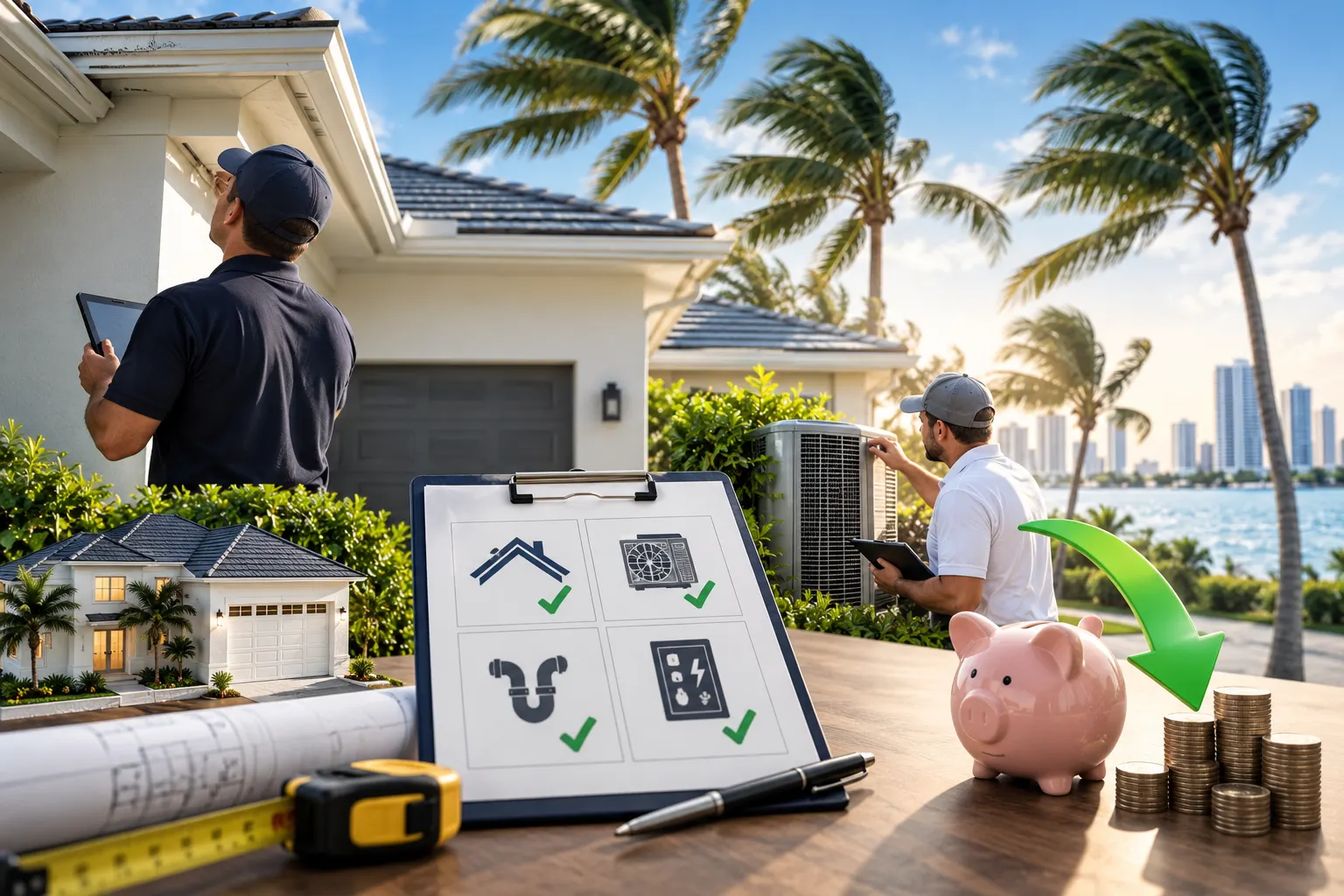
Start with the wind mitigation inspection, which costs $75 to $150 and commonly saves $800 to $2,500 a year. Roof-to-wall straps and impact-rated openings drive the biggest credits. Upgrade straps to double wraps during a roof replacement, since that is the only affordable moment to do it. The four-point mainly determines whether carriers will insure you at all.
The Two Inspections Do Very Different Jobs
Owners often lump these reports together, though they serve opposite purposes. On the Discover South Florida Podcast, Larry Mastropieri identified which one moves your premium.
"Usually the wind mit is a big piece of the puzzle."
Wind mitigation earns discounts on the windstorm portion of your policy, which represents 30% to 70% of a coastal premium. Florida Statute 627.0629 requires every property insurer to apply those credits, so you claim these savings instead of negotiating them.
A four-point inspection works differently, since it determines whether a carrier will write the policy at all. Larry frames it as a threshold question.
"A lot of the other stuff is like go or no go."
How Much Does Roof Age Matter?
Nothing matters more than the roof, and age limits vary by material. Larry lists the thresholds carriers generally apply.
"A tile roof is usually 25 years for the insurance company. A shingle roof is usually 20 years. A flat roof can be like 15 years plus or minus."
Condition still factors into the decision.
"It just depends on condition, how everything looks."
A roof approaching those limits caps what any discount can accomplish, since carriers weigh remaining useful life before they credit the features.
The Missing Permit Problem
Undocumented work creates a separate obstacle that surprises sellers regularly.
"Non-permitted roofs are a whole other disaster. It's like, hey, I replaced this 10 years ago. Well, I can't find a permit, and so neither can the inspector. And so now we have a real issue there."
An unpermitted roof may effectively carry its original age for underwriting purposes. Owners across Palm Beach County should pull permit records before assuming a past replacement counts in their favor.
Roof-to-Wall Straps Are the Credit Nobody Knows About
The most valuable information in this discussion involves hardware most homeowners have never heard of. Larry explains what the inspector is looking for.
"There's a fastener, a strap that straps the roof beams to the concrete block so the roof doesn't just fly away."
Four classifications exist, and the gap between them is enormous.
"It's toenails, clips, single wraps, double wraps. Toenails are the worst and they charge you the most for insurance. Double wraps are the best."
Homes built before roughly 1993 typically carry toenail connections, which earn little or nothing. Single wraps meet current building code for new construction, and this category frequently produces the largest line item on the form. Owners of older homes in Delray Beach and Boca Raton often sit in the weakest classification without knowing.
Replace the Roof, Upgrade the Straps
The moment you choose determines whether this upgrade makes financial sense, and Larry treats it as standard practice across his portfolio.
"Whenever I replace a roof, because this is kind of the time you do it, I make sure we double wrap or double strap the roofs. Then I get all the photos, and then we make sure it's updated on the wind mitigation report to double."
The knowledge gap costs owners real money every year.
"Most people don't know about clips, toenails, single, double wraps. Most people have no clue about this. So people re-roof their roof and don't do this because they don't know, and then they're still questioning why their insurance is higher."
His arithmetic on the upgrade is the part worth acting on.
"You could have just paid an extra four or five grand to get out of that toenail world and into this double wrap thing, and your insurance would drop dramatically. You'd get your payback so fast in some cases."
Got a roof replacement coming or a renewal you cannot afford? Talk to a real estate agent near Boca Raton who knows which upgrades actually move a premium and which ones waste your money. Reach out to The Mastropieri Group or call (561) 544-7000.
The Form Grades Your Weakest Connection
One rule governs this category and catches owners off guard. The inspector records the weakest attachment found anywhere on the structure. A single section of toenails therefore limits your entire rating, no matter how well the rest was done.
Photograph everything while the connections stay visible during the tear-off. The revised form now requires at least one proof photo per rated feature. Documentation gathered after the roof closes up costs far more to obtain.
Opening Protection Follows an All-or-Nothing Rule
Impact windows and shutters produce the largest single credit available, and they also carry the strictest requirement. Larry states it without qualification.
"You have to have total protection per the wind mit. Everything has to be done. That's garage doors, that's front doors, that's back doors, that's windows. That's the tiny window here."
The form confirms his warning exactly. One unprotected window, skylight, or glazed garage door eliminates the entire credit, which can run $1,500 to $3,500 annually in coastal markets.
- Impact-rated windows and doors carrying proper product approval labels.
- Code-approved shutters, panels, or accordion systems covering every opening.
- A reinforced or impact-rated garage door, which owners forget most often.
- Protection on skylights and small bathroom or hallway windows.
- Coverage on sliding glass doors and any glazed entry door.
Decorative shutters, interior blinds, and window film earn nothing at all. Homeowners across West Palm Beach lose the full credit over one overlooked opening. Larry describes the approach his team takes across their properties.
"We've just gone through this exercise of trying to fortify all our stuff one way or another, just so we can get that insurance premium as low as possible."
The Other Categories on the Form
Seven features get rated, and the remaining ones still carry meaningful weight.
- Roof deck attachment, where ring-shank nails at tight spacing far outperform staples.
- Roof shape, since a full hip roof sheds wind better than a gable and earns a credit.
- Secondary water resistance, meaning a peel-and-stick barrier beneath the covering.
- Roof covering compliance with the building code in effect at installation.
- The building code era, reflecting standards in force when the home went up.
Florida revised this form effective April 1, 2026, marking the first major rewrite since 2012. The update added design wind speed regions, roof slope, and FORTIFIED designations, along with a performance-based pathway for documenting retrofitted connections. Anyone holding an older report should ask whether a fresh inspection would classify the home differently.
What Does the Four-Point Actually Decide?
Eligibility drives this report instead of pricing, and electrical systems cause the most trouble. Larry explains how the outcome usually plays out.
"Electric panel is on the bad list for insurance. A lot of insurance companies don't want to insure you. Or maybe you don't qualify for the cheapest insurance product with a specific provider because you have a specific panel."
Alternatives exist at a cost.
"There's other insurers that will insure you, but by default their rates are higher."
The four-point covers electrical, plumbing, heating and cooling, and the roof on homes generally older than 20 years. Certain findings function as automatic disqualifiers with many carriers, so buyers touring Broward County homes should ask about panel type and plumbing material early.
What These Inspections Cost
The economics here favor the homeowner overwhelmingly. A private wind mitigation inspection runs $75 to $150 and takes under an hour. The My Safe Florida Home program offers it at no charge for qualifying owners.
Your completed form stays valid for five years and transfers across carriers, since every insurer must accept the same statewide document. You can therefore shop your policy without ordering another inspection. Typical savings land between $800 and $2,500 annually, so the report pays for itself within weeks. Owners in Palm Beach Gardens routinely recover the fee on their first renewal.
Build the Team Before You Spend
Larry treats this as a coordination problem involving three professionals.
"This is a strategy discussion with your realtor who should know what I know, and then your insurance broker, and then also your inspector."
He pushes inspectors to explain their reasoning instead of accepting the report at face value.
"Hey, why did you choose this? Show me. Walk me through this report, please."
The decision then reduces to arithmetic.
"This is what I need to do, spend here, this is how much it's going to cost me, and this is my savings. Is this worth it or not worth it?"
Where to Start This Week
- Order a wind mitigation inspection, or check My Safe Florida Home eligibility first.
- Confirm your roof age and locate the permit for any past replacement.
- Ask your inspector to identify your current roof-to-wall classification.
- Inventory every opening, including skylights and the garage door.
- Request quotes with and without proposed upgrades applied.
- Time any strap upgrade to coincide with your next roof replacement.
Discount amounts vary by carrier and property, and this page describes general practice. Your insurance broker should quantify savings for your specific home before you commit to any upgrade.
Spend Once, Save Every Year After
Most South Florida owners overpay on insurance because nobody walked them through the form line by line. We connect you with inspectors and brokers who explain each credit line by line. Some upgrades return their cost quickly, and we will tell you which ones do not. A roof replacement is the one moment when the expensive fixes become affordable. Reach out to The Mastropieri Group, Realtors® at (561) 544-7000 and send us your wind mitigation report and we will tell you where the money is.