
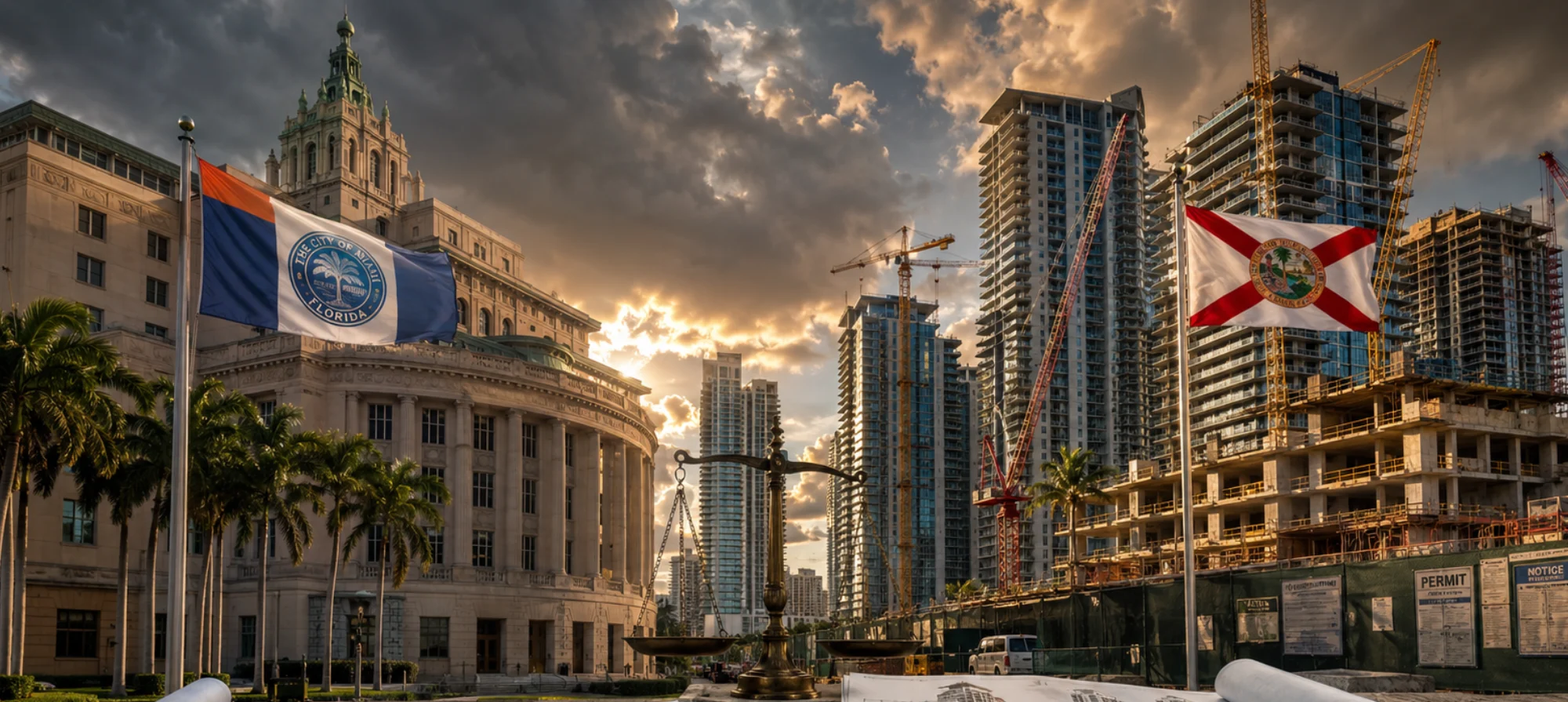
The state just expanded workforce housing rules again. Now Florida's biggest city is exploring whether to sue. This is not about stopping housing. It is about who controls what gets built.
- The Miami City Commission voted unanimously on June 25, 2026, to direct its city attorney to explore a legal challenge to the Live Local Act.
- Miami has permitted 82 Live Local projects, but only two are under construction.
- This is not a lawsuit yet. The city is studying its options before deciding whether to file.
Here is where things stand. On June 25, 2026, the Miami City Commission voted unanimously to direct City Attorney George Wysong to explore every angle for challenging the Live Local Act. That includes constitutional claims, home rule arguments, due process, improper preemption, unfunded mandates, or joining existing lawsuits. According to The Real Deal, this is not a lawsuit yet. The city attorney will report back before any filing happens.
What is Miami actually doing?
As Larry Mastropieri explained on the Discover South Florida Podcast: "Miami has not actually chosen yet to sue the state. They have decided to look into suing the state, and they are going to look into it really hard. That is where this stands right now."
The resolution was sponsored by Commissioner Damian Pardo and co-sponsored by Chair Christine King. Here is the important context: Pardo has previously backed density increases for Miami developers. This is not an anti-development move. The fight is about control, specifically who gets to decide what gets built and where.
The core grievance is that the Live Local Act overrides Miami 21, the city's 2009 zoning code that normally sends large projects to city review boards. The planning director told commissioners that the state law undercuts that framework. Chair King pointed to a proposed 55-story Overtown project that the city had little power to shape as an example of what they are dealing with.
How many Live Local projects are actually getting built?
This is the part that does not get enough attention. According to the city's planning director, Miami has permitted 82 Live Local projects. Only two are under construction. Statewide, more than 200 projects have been proposed under Live Local, but fewer than 20 have broken ground.
So the law is generating a lot of approvals, but not a lot of actual housing yet. That gap between permits and construction is part of what makes this fight complicated. The state wants to force more approvals. Cities want more control over the process. And the actual housing pipeline is not moving as fast as either side expected.
Trying to understand how Live Local affects your market? Talk to a real estate agent in South Florida who tracks zoning changes and new construction. Reach out to The Mastropieri Group or call (561) 544-7000.
What other cities are fighting Live Local?
Miami is not alone. This is turning into a statewide tug-of-war over who controls local zoning. Here is where the fight stands elsewhere:
Hillsborough County: Sued the state in March 2026, arguing that the Live Local Act is unconstitutional. That case is pending.
Hollywood: Won a case against a developer in March 2026, but on narrow grounds. The developer wanted to match the height of the nearby Margaritaville resort under Live Local's height-matching provision. The city argued that Margaritaville got its height through a discretionary approval, not by-right, so it should not count as a benchmark. The judge agreed. It was a technicality win, not a broad ruling against the law.
Miami Beach: Sued by developer Pebb Capital in December 2025 for rejecting a Live Local project. That case is pending.
Bal Harbour: Whitman Family Development (owner of Bal Harbour Shops) sued the Village of Bal Harbour in January 2024. That litigation is ongoing.
Most of these cases pit developers against municipalities. Miami's move is different. Here, a municipality is directly challenging the legislation itself. The only other government to do that is Hillsborough County.
Why did the state make it harder to fight Live Local?
The state saw this coming. The Live Local 2026 update quietly added language expanding who counts as a "person" under the law's fair housing section. Government entities now count as a "person." That means cities and counties can be sued and held liable if they reject an affordable project because of how it is financed or because it is affordable.
In plain terms, the state raised the cost of fighting these projects. Cities used to have more legal immunity. Now they have less. That is why this language is read as the state trying to discourage exactly the kind of pushback Miami is now exploring.
We covered the Live Local 4.0 update when it passed the legislature in March 2026. The fair housing amendment was one of the biggest changes, and it is directly relevant to what Miami is weighing right now.
What happens to projects already in the pipeline?
If Miami does sue and wins something down the road, vested-rights principles generally protect projects that have already pulled permits and broken ground. A ruling would more likely hit projects still in the approval pipeline than ones already under construction.
But that is a long way off. Miami has not filed anything yet. The city attorney is still studying options. And even if they do file, litigation takes years. In the meantime, Live Local projects will continue moving through the system, and the gap between permits and actual construction will widen.
Watch the Full Discussion: This Segment | Full Episode | Last Week's Recap
Frequently Asked Questions about Miami's Live Local Challenge
Is Miami suing the state over the Live Local Act?
Not yet. On June 25, 2026, the Miami City Commission voted unanimously to direct the city attorney to explore legal options for challenging the Live Local Act. The city attorney will report back before any lawsuit is filed. This is a study phase, not a filing.
What is Miami's problem with the Live Local Act?
Miami's core grievance is that the Live Local Act overrides Miami 21, the city's 2009 zoning code. The law forces the city to approve dense projects without the usual local review. City officials say this erodes "home rule," a city's authority over its own land use.
How many Live Local projects are under construction in Miami?
According to the city's planning director, Miami has permitted 82 Live Local projects, but only two are under construction. Statewide, more than 200 projects have been proposed under Live Local, but fewer than 20 have broken ground.
What other Florida cities are fighting the Live Local Act?
Hillsborough County sued the state in March 2026, arguing the law is unconstitutional. Hollywood won a narrow case against a developer in March 2026. Miami Beach and Bal Harbour are both involved in litigation with developers who sued after their Live Local projects were rejected.
Can cities be sued for rejecting Live Local projects?
Yes. The Live Local 2026 update expanded the definition of a "person" under the law's fair housing section to include government entities. Cities and counties can now be sued and held liable if they reject an affordable project because of its financing or its inclusion of affordable housing.
Local help for buyers and investors in South Florida
If you are buying, selling, or investing in South Florida, understanding how Live Local and zoning changes affect property values matters. Reach out to The Mastropieri Group, Realtors®.
For practical, hands-on support across South Florida, call (561) 544-7000.
Posted by Larry Mastropieri







Enjoy this blog post? Click here to subscribe for updates

Leave A Comment