
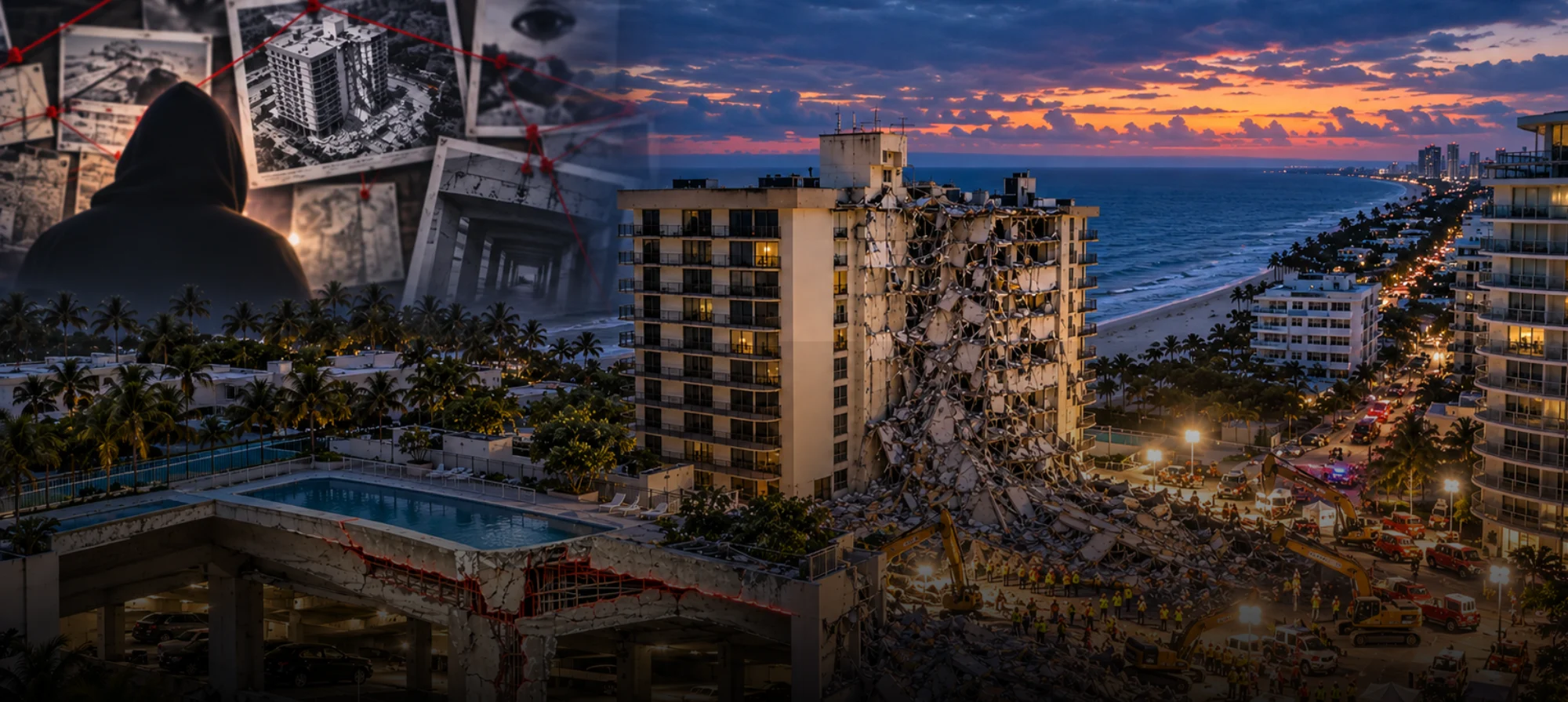
Five years after 98 people died at Champlain Towers South, we have the official findings. The engineering is conclusive, but conspiracy theories keep circulating. Here is what actually happened.
- The pool deck was structurally deficient in the original 1981 design and had been near-collapse capacity since at least 1996.
- A 2018 inspection documented major structural damage and estimated repairs at $9.1 million; those repairs never happened.
- Florida responded with SB 4-D and SB 154, requiring milestone inspections and fully funded reserves for older buildings.
On June 24, 2021, at approximately 1:30 AM, the eastern portion of Champlain Towers South collapsed. The 12-story condominium at 8777 Collins Avenue in Surfside had stood since 1981 and housed 136 units. Ninety-eight people lost their lives in what became the deadliest structural failure in the United States in decades. According to NIST's official June 2026 findings, the collapse began when connections between garage columns and the pool deck failed, triggering a chain reaction through parts of the building that lacked the strength to carry the shifted load. A $1.02 billion settlement was approved by the court in June 2022.
This is a history lesson: what actually happened, what the forensic engineers found, what changed because of it, and at the end, a brief look at the conspiracy theory that has circulated online.
What Did the Forensic Investigation Find?
Wiss, Janney, Elstner Associates (WJE), one of the country's most respected forensic engineering firms, conducted the investigation. Their analysis was published in Structure Magazine in March 2025, and the findings were clear.
The pool deck was structurally deficient from the original design. It was not built to carry the loads it needed to carry. Over the years, renovations added more weight to the deck, including concrete pavers installed in 1996, that the structure was never designed to support. WJE concluded that the deck had been near its collapse capacity since at least 1996, 25 years before it fell.
As Larry Mastropieri explained on the Discover South Florida Podcast: "Visual signs of structural distress were documented as recently as 22 days before the collapse. Some people thought it might be a sinkhole, which people think about in Florida, but that was ruled out. It was poor design, poor engineering from the beginning, and a lack of maintenance and inspections over time."
Engineers tested the ground and confirmed no voids, no sinkholes, and normal soil conditions. The cause was structural, not geological.
Were There Warnings Before the Collapse?
Yes. A 2018 inspection documented "major structural damage" and estimated $9.1 million in repairs. The condo association debated the cost for three years. Repairs never happened. Visible signs of structural distress were documented as recently as 22 days before the building fell.
The WJE report is public and available through Structure Magazine for anyone who wants the full technical detail. We are keeping this as an overview, but the engineering is comprehensive and conclusive.
Buying or selling a condo in South Florida? Talk to a real estate agent who understands post-Surfside inspections, reserve requirements, and what to look for in aging buildings. Reach out to The Mastropieri Group or call (561) 544-7000.
What Changed Because of Surfside?
Florida responded with new legislation. SB 4-D and SB 154 (passed in 2022 and 2023) now require milestone inspections for condo buildings three stories or taller that are 25 years old within three miles of the coast, or 30 years old elsewhere. Buildings must complete a Phase 1 visual inspection, then a Phase 2 detailed assessment if issues are found. Fully funded reserves are now required. Associations can no longer vote to waive reserves.
The results so far: Over 2,500 Florida condo buildings have been flagged for structural deterioration as of 2025. Fifty-four have been deemed unsafe or uninhabitable. The inspection backlog is real, as engineers are overwhelmed with demand.
The financial fallout: Massive special assessments are hitting older condo buildings. The Florida condo crisis we cover regularly on the show traces directly back to Surfside.
Heron Pond in Pembroke Pines is one example: 304 units were evacuated after a structural failure, the association dissolved, and a developer bought the site for $20.5 million. Owners received roughly $67,000 per unit. Portofino South in West Palm Beach is facing $10 million in assessments and a contentious $295 million buyout offer. La Fontana, a 140-unit co-op on Flagler Drive, went under contract for approximately $200 million because repairs were too expensive.
Insurance and financing changed too: Fannie Mae and Freddie Mac ended streamlined condo reviews, meaning every condo now faces a full financial review before a buyer can get a mortgage. A 15% reserve requirement is phasing in by January 2027. Buildings with deferred maintenance or underfunded reserves are becoming harder to finance, which makes units harder to sell.
The bottom line: the Surfside collapse did not just take 98 lives. It fundamentally changed the economics of owning a condo in Florida. Every assessment story, every buyout, every inspection failure we cover on this show traces back to that night.
What About the John McAfee Conspiracy Theory?
We want to be upfront: what follows has circulated widely on social media. We are not presenting it as fact. We are addressing it because many viewers have seen it and asked about it.
John McAfee, the antivirus software creator, was found dead in a Barcelona prison on June 23, 2021, one day before the Surfside collapse. He was awaiting extradition to the United States on tax evasion charges. His wife said he was not suicidal.
What went viral: A screenshot of a tweet allegedly posted by McAfee claimed he stored "31 terabytes of government secrets" on hard drives in a condo "near 88th Street and Collins Avenue." That description matches Champlain Towers South's address (8777 Collins Avenue). The online implication was that the building was deliberately destroyed to eliminate the data.
What the fact-checkers found: Multiple independent organizations (PolitiFact, Snopes, USA Today) investigated and concluded:
The tweet does not exist on McAfee's verified account. It appears to have been fabricated after the collapse. No property records link McAfee to any unit at Champlain Towers South. There is no verified evidence connecting McAfee to the building in any way.
WJE's forensic engineering evidence is clear, comprehensive, and public. The pool deck was structurally deficient from the day it was built in 1981. It was overloaded in 1996. It was showing visible signs of failure for months. The warnings were documented and ignored. The engineering explains what happened.
Watch the Full Discussion: This Segment | Full Episode | Last Week's Recap
Frequently Asked Questions About the Surfside Condo Collapse
What caused the Champlain Towers South collapse in Surfside?
According to the forensic investigation by Wiss, Janney, Elstner Associates, the pool deck was structurally deficient from the original 1981 design. It was not built to carry the loads placed on it, and renovations in 1996 added weight the structure could not support. The deck had been near collapse capacity for 25 years before it fell on June 24, 2021.
How many people died in the Surfside collapse?
Ninety-eight people lost their lives when the eastern half of Champlain Towers South collapsed at approximately 1:22 AM on June 24, 2021. It was the deadliest structural failure in the United States in decades. A $1.02 billion settlement was approved by the court in June 2022.
Was the Surfside collapse caused by a sinkhole?
No. Engineers tested the ground beneath Champlain Towers South and confirmed no voids, no sinkholes, and normal soil conditions. The forensic investigation concluded that structural deficiencies in the pool deck design and decades of deferred maintenance, not geological factors, caused the collapse.
What laws changed in Florida after the Surfside collapse?
Florida passed SB 4-D and SB 154 (2022-2023), requiring milestone inspections for condo buildings three stories or taller that are 25 years old near the coast or 30 years old elsewhere. Fully funded reserves are now mandatory. Associations can no longer vote to waive reserve funding for structural components.
Did John McAfee have a connection to Champlain Towers South?
No. Multiple fact-checking organizations (PolitiFact, Snopes, USA Today) investigated this claim and found no evidence connecting McAfee to the building. The viral tweet claiming he stored data there doesn't appear on his verified account and seems to have been fabricated after the collapse. Property records show no link between McAfee and any unit at Champlain Towers South.
Local Help for Condo Buyers and Sellers in South Florida
If you are buying or selling a condo in South Florida, understanding post-Surfside inspection requirements, reserve studies, and how Florida's condo laws work matters more than ever. Reach out to The Mastropieri Group, Realtors®.
For practical, hands-on support across South Florida, call (561) 544-7000.


Enjoy this blog post? Click here to subscribe for updates

Leave A Comment