
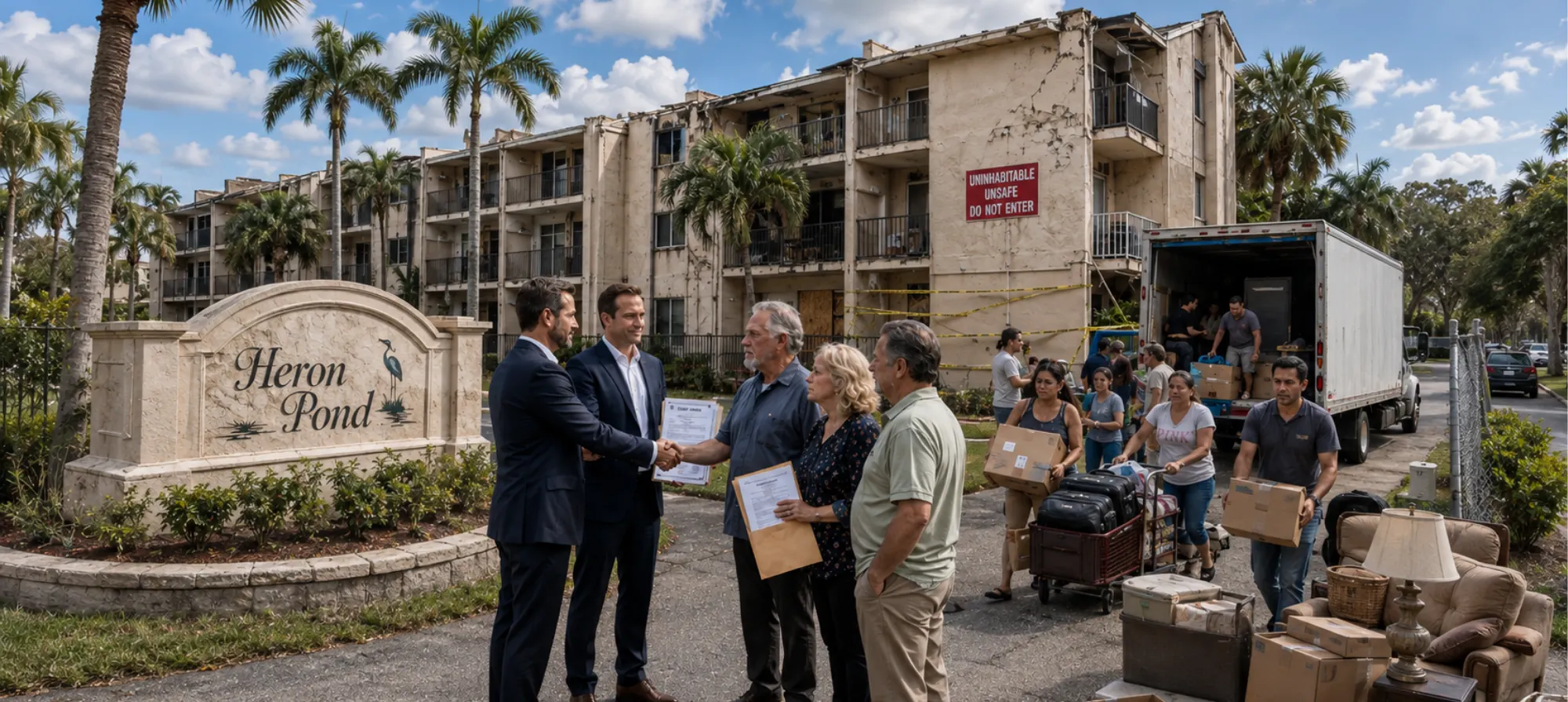
Deferred maintenance. Underfunded reserves. Structural failure. A Broward County condo community became uninhabitable, and the court had to finish what the association could not.
- Heron Pond Condominiums, a 304-unit community on 25 acres at 8400 SW 1st Street in Pembroke Pines, was dissolved by court order and sold to Integra Investments.
- The sale closed July 22, 2026, for $20.5 million, approximately $67,400 per unit or $820,000 per acre.
- Former owners received proceeds minus outstanding mortgages, liens, and legal fees, with some receiving little or nothing.
Heron Pond is one of the clearest examples of what can happen when deferred maintenance, weak condo governance, and structural problems collide. According to South Florida Business Journal, Integra Investments closed on the site in July 2026 after a court-appointed receiver managed the dissolution process. The Miami-based developer may turn the site into a successful redevelopment. Still, for the former residents, this is a brutal reminder that condo association management and building maintenance are not small details. They can determine whether people keep or lose their homes.
What happened at Heron Pond?
Heron Pond was a 304-unit lakefront community with 19 two-story buildings on approximately 25 acres at 8400 SW 1st Street in Pembroke Pines, according to The Real Deal. The property was built in 1988. For decades, it was an affordable option for working families in western Broward County.
City officials ordered residents to vacate the 304 units in August 2024 due to "significant structural issues" that deemed all units "unsafe for occupancy," Pembroke Pines News reported. The buildings suffered from moisture damage, termite damage, and structural deficiencies tied to what court documents described as "inadequate design and inadequate construction practices."
Court-appointed receiver Daniel Stermer, the former Weston Mayor, determined that repairs would be too costly and opted to dissolve the condo association and sell the property. The Real Deal reported that dissolution was granted on August 14, 2025. Integra Investments was named the stalking horse bidder in September 2025, and the sale closed on July 22, 2026, for $20.5 million. Avison Young and Fisher Auction arranged the sale.
What did former owners receive?
This is the painful part. When a condo is dissolved and sold, proceeds go first to satisfy debts: outstanding mortgages, property taxes, special assessments, liens, receiver fees, and legal costs. Only what remains gets distributed to former owners based on their ownership percentage.
At an average of approximately $67,400 per unit, many owners received little or nothing. Some had mortgages that exceeded their share of the sale proceeds. Others who had paid off their mortgages and owned free and clear fared better but still received far less than they might have gotten in a normal sale before the buildings failed.
This is why Florida's condo crisis matters so much. When a building reaches the point of dissolution, there are no good outcomes for owners. The question is only how bad the losses will be.
Concerned about your condo's structural condition or reserves? Talk to a real estate agent in Broward County who can help you evaluate your options before problems become emergencies. Reach out to The Mastropieri Group or call (954) 833-1468.
Why could the buildings not be saved?
As Larry Mastropieri explained on the Discover South Florida Podcast: "The buildings needed so much money to fix that it did not even make sense to touch them. At some point, you look at it and say, it would be crazy to repair this, we might as well build a new building. But no one in that community could afford to build a new building, so the court had to solve it by selling the property."
This is the math that kills older condos. When repair costs exceed the property's value, there is no financial path to saving the building. A special assessment of $50,000 or $100,000 per unit might fund repairs, but if the units are only worth $80,000 after repairs, no rational owner would pay. And most owners cannot afford assessments that large.
Florida's post-Surfside inspection requirements have accelerated this reckoning. Buildings that might have limped along for another decade are now being forced to confront structural realities they can no longer ignore. More than 2,500 Florida condos have been flagged for deeper structural review, and some will face the same fate as Heron Pond.
What will Integra do with the site?
Integra Investments is a Miami-based developer led by principals Paulo Tavares de Melo, Nelson Stabile, Victor Ballestas, and Cory Yeffet, according to The Real Deal. The firm has a track record in multifamily and mixed-use projects. Integra has not announced specific plans for the Heron Pond site, but the likely outcome is demolition and redevelopment.
The in-place zoning allows up to 321 units by right, and the unit count could more than double through upzoning or a land-use plan amendment, Connect CRE reported. At approximately 25 acres, the $20.5 million purchase price works out to roughly $820,000 per acre.
Pembroke Pines is a mature suburb with good schools, retail access, and proximity to I-75 and the Sawgrass Expressway. Integra bets that the site's value as developable land exceeds the distressed condo community's value.
What should condo owners learn from Heron Pond?
Heron Pond is a cautionary tale, but it is not unique. Buyouts and dissolutions are becoming more common as post-Surfside laws force aging buildings to confront deferred maintenance. Here is what condo owners should take away:
Review your reserve study: Florida law now requires condos to complete Structural Integrity Reserve Studies (SIRS) and fully fund reserves. If your building has not done this, ask why. Underfunded reserves are the first warning sign.
Attend board meetings: Most owners ignore association governance until a crisis arises. By then, it is too late. Pay attention to what the board is doing, what repairs are being deferred, and how reserves are being managed.
Understand your exposure: If your building faces a major special assessment, know what your options are. Can you afford to pay? Can you sell before the assessment hits? What happens if the building is dissolved?
Consider selling early: If your building is aging and underfunded, the best time to sell may be before problems become public. Once a building is flagged for structural issues, unit values collapse, and buyers disappear.
Watch the Full Discussion: This Segment | Full Episode | Last Week's Recap
Frequently Asked Questions about Condo Dissolution in Florida
What is condo dissolution?
Condo dissolution is a legal process in which a condominium association is terminated, and the property is sold, typically to a developer. In Florida, dissolution can occur voluntarily (with the owner's approval) or through a court order when a building is deemed unsafe or financially unviable. Proceeds from the sale are distributed to owners after debts, liens, and legal costs are paid.
Can a court in Florida dissolve a condo association?
Yes. When a condo building is deemed unsafe and repairs are financially unviable, a court can appoint a receiver to dissolve the association and sell the property. This is what happened at Heron Pond in Pembroke Pines, where 304 units were evacuated, the association was terminated, and the site was sold to Integra Investments for $20.5 million in July 2026. Proceeds were distributed to former owners after debts, liens, and legal costs were paid.
What are Florida's post-Surfside condo inspection requirements?
Following the 2021 Surfside collapse, Florida passed SB 4-D requiring milestone structural inspections for buildings 30 years or older (25 years if near the coast), with inspections every 10 years thereafter. Condos three stories or higher must complete Structural Integrity Reserve Studies (SIRS) and fully fund reserves. Associations can no longer waive reserve contributions.
What happens to condo owners when a building is dissolved?
When a condo is dissolved and sold, proceeds first pay outstanding debts including mortgages, property taxes, liens, receiver fees, and legal costs. Remaining funds are distributed to owners based on their ownership percentage. Owners with mortgages exceeding their share may receive nothing. Owners who owned free and clear typically receive more, but often far less than their units were worth before the building failed.
How can condo owners protect themselves from dissolution?
Owners should review their building's reserve study, attend board meetings, and understand their exposure to special assessments. If a building is aging and underfunded, selling before problems become public may be the best option. Once structural issues are disclosed, unit values typically collapse and finding buyers becomes difficult.
Local help for buyers and sellers in Pembroke Pines
If you are buying, selling, or evaluating a condo in Pembroke Pines or Broward County, understanding how structural requirements and reserve funding affect your investment matters. Reach out to The Mastropieri Group, Realtors®.
For practical, hands-on support across Broward County, call (954) 833-1468.




Enjoy this blog post? Click here to subscribe for updates

Leave A Comment