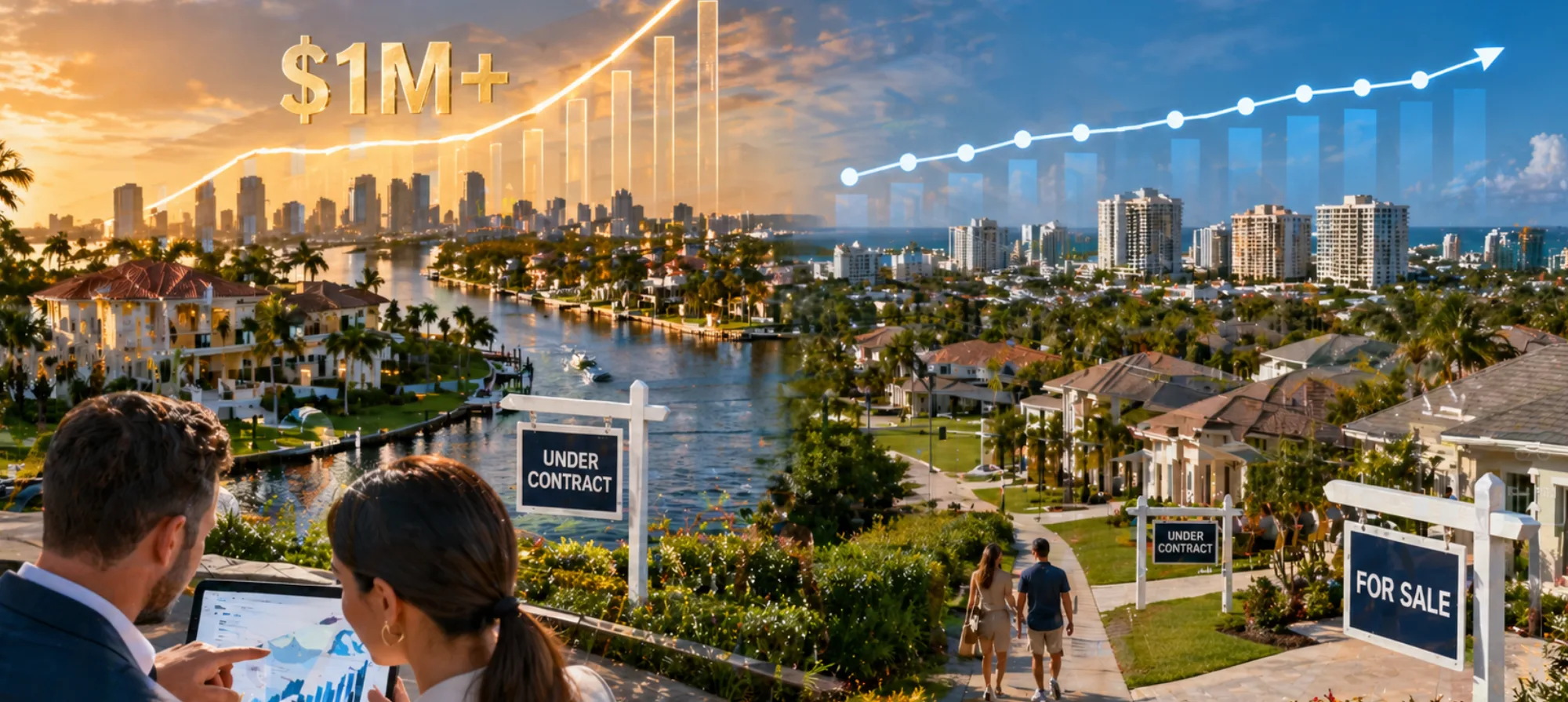
Palm Beach County just crossed $1 million in average sale price for the first time. Broward County is stabilizing. Inventory is down in both markets. Here's what the Q1 2026 housing data shows for buyers, sellers, and investors.
Key Takeaways
- Palm Beach County's average sale price rose 11% to $1,025,233, crossing $1 million for the first time.
- Total inventory dropped 8% in Palm Beach and 7% in Broward, tightening supply in both markets.
- Under-contract activity surged 11% in Palm Beach and 9% in Broward, signaling strong Q2 closings ahead.
For Q1 2026, both Palm Beach County and Broward County showed broad-based improvement across absorption rates, inventory, and under-contract activity. Palm Beach is leading with rising prices and sales volume. Broward is stabilizing. But beneath the headline numbers are important distinctions between price segments, between counties, and between buyers who are acting now and those who are waiting.
What do the Palm Beach County numbers show?
Palm Beach County is the clear leader in Q1 2026. The average sale price rose 11% year-to-date, from $924,049 to $1,025,233, crossing $1 million for the first time. The median sale price increased 3% to $518,500, showing healthy, sustained appreciation across the market.
Sold homes increased 6% while under-contract activity jumped 11%. That momentum is real. Total inventory dropped 8% (from 28,070 to 25,945 homes), and new listings fell 11%. Supply is tightening while demand stays strong.
Two price segments are now in seller's market territory: the $500K to $750K range (4.66 months absorption) and the $1M to $1.5M range (5.25 months). The luxury segment above $1.5M improved dramatically from 12.75 months to 8.22 months. Palm Beach County's wealth boom continues to drive demand at the high end.
What is driving prices higher?
As Larry Mastropieri noted on the Discover South Florida Podcast: "What we're seeing is a ton of activity in the $1.5 million-plus range. Luxury condos and high-end homes are closing at a strong pace. That's really what's driving a lot of the headline numbers. The wealth movement into South Florida is very real. These numbers show that without question. Capital is continuing to flow into the market at a high level."
The inventory decline is partly a function of sellers not listing, not just buyers buying. The "lock-in effect" from homeowners with sub-4% mortgages who will not sell into a 7%+ rate environment is real. When supply shrinks, and demand holds, prices rise.
As Larry explained: "When inventory drops, and demand stays the same, that creates upward pressure on prices. It's a basic supply-and-demand equation. That's why this trend matters so much."
Thinking about buying or selling in this market? Talk to a Boca Raton real estate agent who understands how these trends affect your specific price range. Reach out to The Mastropieri Group or call (561) 544-7000.
How is Broward County different?
Broward County is stabilizing, but it is a different story from Palm Beach. The average sale price jumped 32%, but this is misleading. That increase was driven by 56 more sales above $1.5 million (many over $5 million) compared to last year. The median sale price actually dropped 1% to $450,000. The typical Broward home is flat or slightly down.
Sold homes declined 2% year-to-date, so Broward is still contracting slightly. But under-contract activity rose 9%, meaning buyers are active and closings will follow in Q2. Total inventory dropped 7%, and new listings fell 15%, a significant supply reduction.
The $500K to $750K range in Broward is now in seller's market territory, with a 5.36-month absorption rate. But the entry-level segment under $500K remains deeply in buyer's market territory at 9.37 months. Broward is a bifurcated market. Contract activity trends have been a reliable leading indicator for both counties.
What does this mean by price segment?
Palm Beach County Absorption Rates:
- Under $500K: 6.53 months (improved from 7.69)
- $500K to $750K: 4.66 months (seller's market)
- $750K to $1M: 5.73 months (improved from 7.32)
- $1M to $1.5M: 5.25 months (seller's market)
- $1.5M+: 8.22 months (improved dramatically from 12.75)
Broward County Absorption Rates:
- Under $500K: 9.37 months (still slow)
- $500K to $750K: 5.36 months (seller's market)
- $750K to $1M: 6.73 months (improved from 8.66)
- $1M to $1.5M: 6.94 months (improved, still buyer's market)
- $1.5M+: 11.67 months (improved from 14.47, but still very slow)
Both markets improving simultaneously across all segments is the most significant signal in this report. It is the first time we have seen broad-based absorption improvement in both counties at the same time. The migration story may be evolving, but capital continues to flow into South Florida real estate.
What should buyers and sellers watch?
The under-contract surge (+11% Palm Beach, +9% Broward) is a leading indicator. Those buyers close in Q2. Expect Q2 2026 sold volume to be stronger than Q1 in both counties.
The days-on-market increase (Palm Beach: +8%; Broward: +12%) signals that buyers are taking longer to decide. This market is not the frenzy of 2021 and 2022. Sellers must price correctly from the start.
Palm Beach buyers in the $500K to $1.5M range are already in a seller's market. Waiting costs negotiating leverage. Broward buyers still have leverage, especially below $500K and above $1M, but absorption is tightening. First-time buyers should pay close attention to these segment-level dynamics.
FAQs about the Q1 2026 South Florida housing market
What is the average home price in Palm Beach County in Q1 2026?
The average sale price in Palm Beach County rose 11% to $1,025,233, crossing $1 million for the first time. The median sale price increased 3% to $518,500.
Is it a buyer's or seller's market in Palm Beach County?
It depends on the price segment. The $500K to $750K and $1M to $1.5M ranges are in seller's market territory (with under 6 months of absorption). The luxury segment above $1.5M improved but remains more balanced at 8.22 months.
How is Broward County performing compared to Palm Beach?
Broward is stabilizing while Palm Beach is growing. Broward median prices are flat (down 1%), but under-contract activity rose 9%, and inventory dropped 7%. The $500K to $750K segment is now a seller's market in Broward.
Why did Broward's average price jump 32%?
The 32% increase is misleading. It was driven by 56 additional sales above $1.5 million (many over $5 million). The median price, which better reflects the typical transaction, dropped 1% to $450,000.
What should buyers watch in Q2 2026?
Watch whether new listings continue to decline into summer. Supply restraint is the single biggest driver of price sustainability. Any Fed rate cut in 2026 could unlock sellers who have been "locked in" by low mortgage rates.
Local help for buyers and sellers across South Florida
If you are buying, selling, or investing in Boca Raton, Palm Beach County, or Broward County, understanding segment-level market data matters. Reach out to The Mastropieri Group, Realtors®.
For practical, hands-on support across South Florida, call (561) 544-7000.
Posted by Larry Mastropieri

Enjoy this blog post? Click here to subscribe for updates

Leave A Comment