
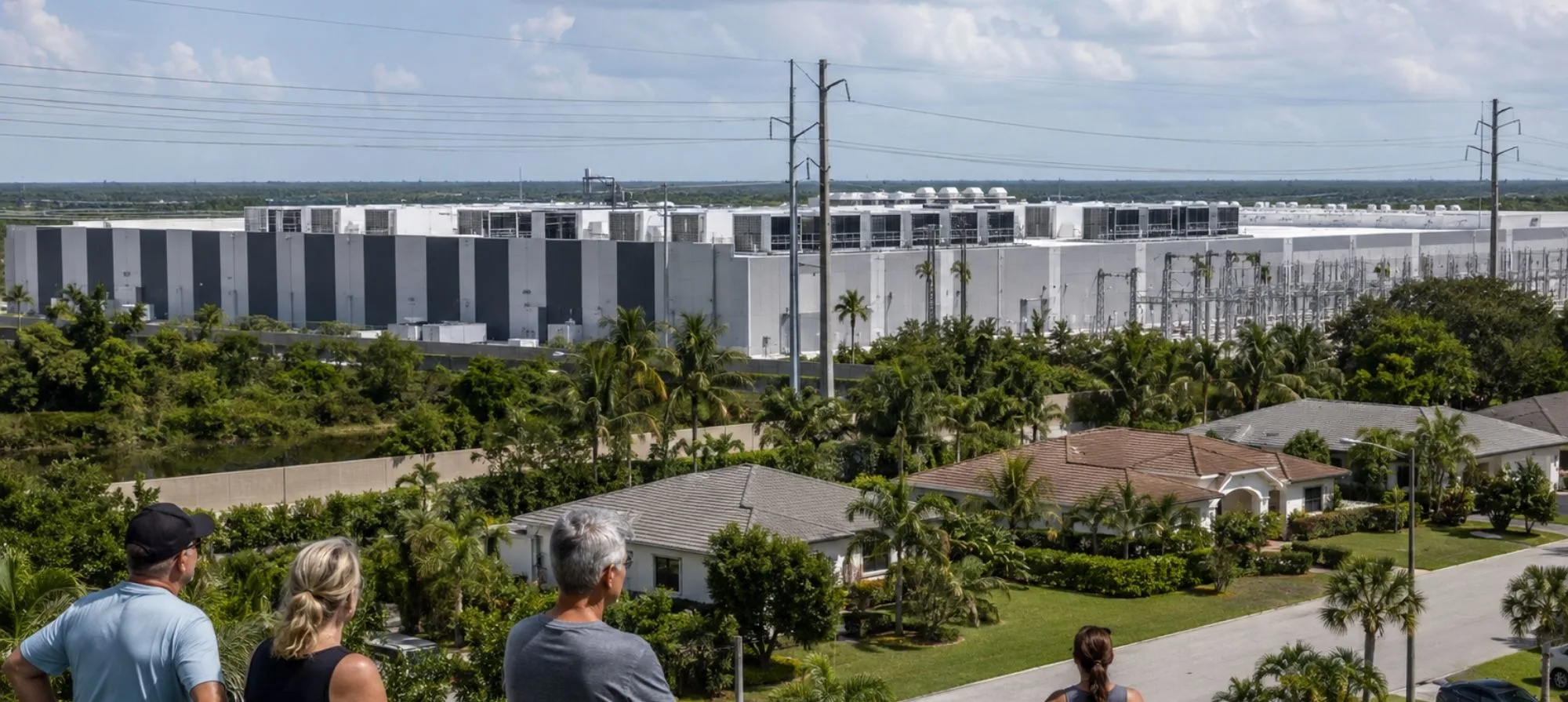
Developers are proposing billion-dollar server farms across the state, but county after county is voting them down over water, power, and property values. Palm Beach just rejected its biggest one and is moving to ban new ones for a year.
Key Takeaways
- Developers have proposed at least a dozen hyperscale data centers across Florida, but counties are increasingly rejecting them and passing moratoriums.
- Palm Beach County commissioners rejected Project Tango, a $2.6 billion data center near Wellington, and on August 27 advanced a one-year ban on large projects.
- Residents cite higher power bills, heavy water use, noise, and falling property values, along with very few permanent jobs.
Everyone wants AI, but almost nobody wants the giant, power-hungry building that makes it run sitting in their backyard. That tension is playing out across Florida right now. According to The Real Deal, developers have proposed at least a dozen hyperscale data centers around the state, and the reception has been rough. One major project got approved, South Florida's biggest was rejected, and county after county is now slamming the door with moratoriums.
How much money is flowing into Florida data centers?
Hyperscale data centers can span millions of square feet and draw as much power and water as a small city, and they have become one of the hottest commercial real estate plays as tech giants race to build out AI. McKinsey projects $6.7 trillion in global data-center investment by 2030, with $5.2 trillion of that driven by AI alone, and US construction spending on these facilities just hit an all-time high of $50 billion.
Florida's marquee approved project is the Fort Meade Data Center Campus in Polk County, a $2.6 billion, 4.4-million-square-foot development on a former phosphate mine, sweetened by a $150 million county tax break. Even that one is already facing two lawsuits and a recall effort. The land grab is real, and it has reached some unlikely places, including a former safari park eyed for a data center.
Why did Palm Beach County reject Project Tango?
South Florida's flashpoint was Project Tango, formally the Central Park Commerce Center, a $2.6 billion hyperscale data center proposed for Loxahatchee, near Wellington, by developer PBA Holdings. After a marathon July 15 hearing that drew hundreds of residents and more than 80 speakers overwhelmingly against it, county commissioners voted 5 to 1 to deny the project. The denial came "without prejudice," so the developer can reapply, and PBA is now appealing.
What makes the rejection striking is the site itself. As Larry Mastropieri pointed out on the Discover South Florida Podcast, the parcel sits right next to a power plant: "It's the most industrial location you can find probably in Palm Beach County." Even there, residents packed the room to say no. We broke down the stakes in what Project Tango could mean for Palm Beach County.
Why are residents so fiercely opposed?
Residents are worried less about data centers in the abstract than about concrete costs close to home. The same fears show up in every fight: strain on the power grid and higher electricity bills, since these facilities draw enormous, constant power; heavy water use for cooling in a state that guards its aquifers; round-the-clock noise from cooling systems; and falling property values for homes near the sites.
There is also a "why here?" resentment, because data centers provide a large tax base and construction dollars but very few permanent jobs. Neighbors feel they absorb the downsides, from traffic to utilities to aesthetics, without the employment upside. That combination is why normally quiet county hearings have turned into packed, hours-long showdowns, part of a wider data center backlash across South Florida.
Worried about how a nearby data center or big development could affect your home's value? Land-use fights move fast, and they move prices. Talk to a real estate agent near Wellington who tracks these decisions. Reach out to The Mastropieri Group, Realtors® or call (561) 556-9853.
How is Florida handling the data center boom?
Here is what makes this fight different from Florida's housing battles. With data centers, the state is reinforcing local control rather than overriding it. In May 2026, Governor DeSantis signed SB 484, the Florida Hyperscale Data Center Act, which preserves local governments' authority to reject data centers, bars utilities from passing their costs on to residents, and adds protections for the state's water.
So unlike the Live Local Act, where Tallahassee forces cities to allow housing by right, here the state is helping cities say no. And counties are using that power. Palm Beach County advanced a one-year moratorium on large data centers on August 27, joining more than a dozen Florida jurisdictions that have paused or banned them, with Jackson and Wakulla counties banning large projects outright. Still, as Larry noted, the demand is not going away, and a project rejected in one county tends to resurface in another, so the fight is really about where these centers land more than whether they get built at all.
Watch More on This Topic: Watch this segment | Full Episode | Last week's recap
Frequently Asked Questions
What is a hyperscale data center?
A hyperscale data center is a very large facility, often millions of square feet, filled with the servers that power cloud computing and artificial intelligence. These sites draw enormous, constant amounts of electricity and use large volumes of water for cooling, which is why their power and water demands are central to nearly every local fight over them.
Why did Palm Beach County reject Project Tango?
Commissioners voted 5 to 1 to deny Project Tango after a marathon July 15 hearing where residents raised concerns about water use, power demand, noise, traffic, and effects on nearby property values. The denial was made "without prejudice," meaning the developer, PBA Holdings, can reapply, and it is currently appealing the decision.
What is Florida's data center moratorium?
A moratorium is a temporary pause on approving new projects. More than a dozen Florida counties have adopted or are weighing one-year pauses or outright bans on large data centers. Palm Beach County extended its one-year moratorium on August 27, giving officials time to draft rules for these facilities.
Do data centers lower nearby property values?
Many residents fear they do, which is a major reason for the opposition. Concerns center on noise from constant cooling systems, heavy industrial use next to homes, strain on utilities, and general undesirability, all of which can weigh on values for the closest properties. The long-term effect depends heavily on the specific site and design.
How is the state of Florida involved?
In May 2026, Governor DeSantis signed SB 484, the Florida Hyperscale Data Center Act. It preserves local governments' authority to approve or reject data centers, prevents utilities from passing the facilities' costs on to residential customers, and adds water protections, effectively backing communities that want to say no.
Local help for Palm Beach County buyers, sellers, and investors
Whether you own near a proposed project, are buying in the western communities, or just want to understand how land-use fights shape values, it helps to work with a team that follows local development closely. Reach out to The Mastropieri Group, Realtors® in West Palm Beach, or call (561) 556-9853 for practical, hands-on guidance across South Florida.
Posted by Larry Mastropieri



Enjoy this blog post? Click here to subscribe for updates

Leave A Comment