
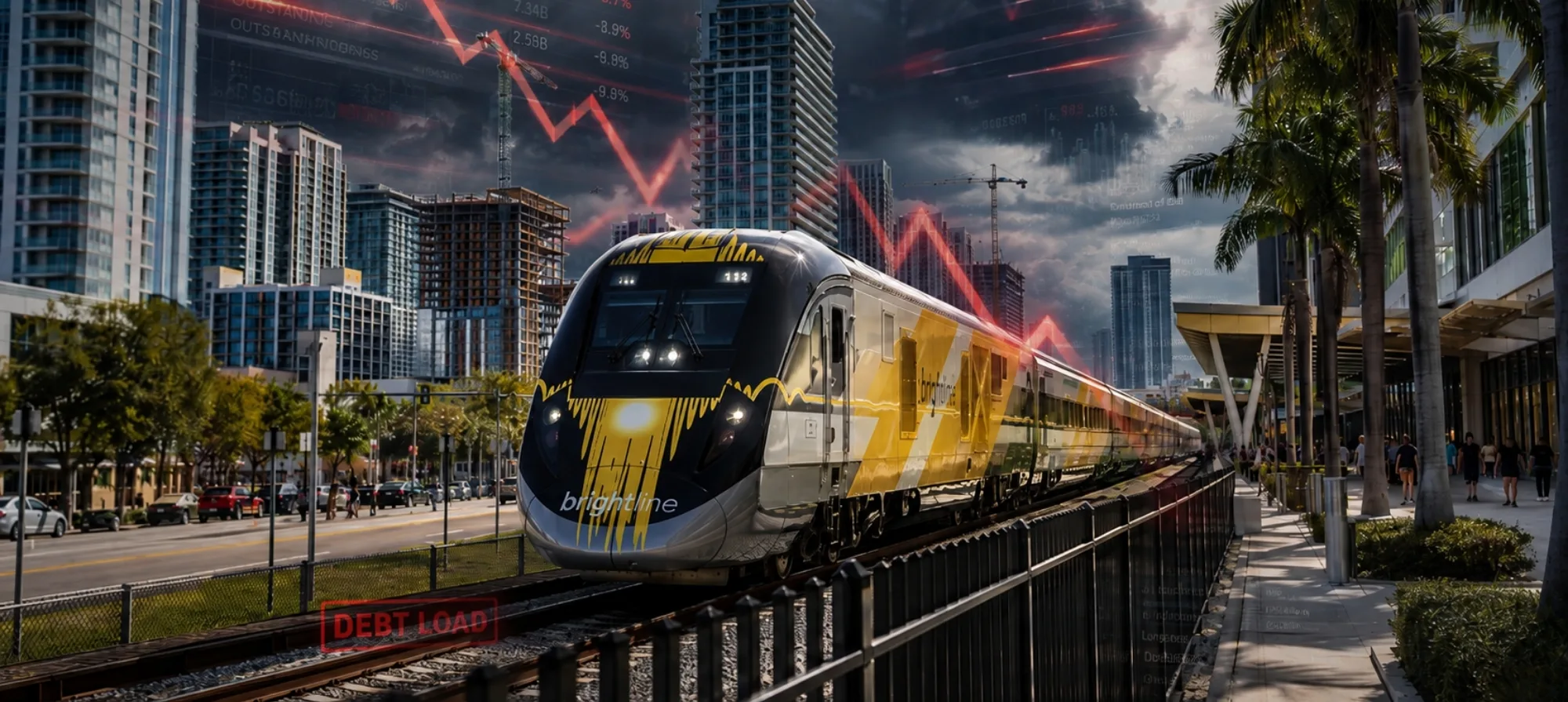
The train carries $4.9 billion in debt and may be headed for a restructuring, yet ridership keeps hitting records. Real estate leaders argue it has catalyzed too much development to let it slip off the rails.
Key Takeaways
- Brightline carries about $4.9 billion in debt, and its auditors have raised doubts about the company's ability to continue, with a restructuring or bankruptcy widely expected.
- Ridership is actually growing and setting records; the real problem is that revenue still cannot cover operating costs and interest on debt.
- South Florida real estate leaders argue the train has catalyzed billions in development and is too important to the region to let it fail.
Brightline's finances look shaky, but South Florida has quietly bet a decade of growth on the train staying on the tracks. According to the South Florida Business Journal, the higher-speed rail line carries about $4.9 billion in debt. It is widely expected to restructure or file for bankruptcy, yet a chorus of real estate and business leaders is arguing it is simply too important to let it fail. To understand why, it helps to look at what Brightline's troubles actually mean for the region.
How much trouble is Brightline actually in?
Brightline Florida carries roughly $4.9 billion in debt from building its Miami-to-Orlando system, and by some counts the total load runs higher still. Its independent auditors have raised doubts about whether it can continue operating, it has deferred bond payments this year, and Fitch has warned of a very high probability that it will miss upcoming debt-service payments.
Credit ratings have been cut to junk, creditors are circling, and a debt restructuring or bankruptcy is widely expected within months. The company, owned by Fortress Investment Group and billed as the first privately funded passenger railroad built in the United States in a century, has been in talks to bring in new investors or reshape its balance sheet. Because much of that debt was raised through tax-exempt bonds, some critics argue the railroad was never as purely private as advertised, and worry that a collapse could land on bondholders and, indirectly, the public.
If ridership is up, why is it losing money?
Here is the counterintuitive part: the problem is not empty trains. Brightline has been setting monthly ridership records, carrying about 1.5 million passengers in the first five months of 2026, up double digits from a year earlier, and a new CEO who came from Europe's Eurostar has added capacity and lifted fares and extras.
But the system was built with so much debt that ticket and ancillary revenue still cannot cover operating costs plus interest. Ridership, while growing, came in well below the projections in the original bond prospectus. So the trouble sits on the balance sheet rather than on the platforms, which is exactly why South Florida real estate investors still believe in it.
Why do real estate leaders want to save it?
This is where the "too big to fail" argument comes in. Real estate and business leaders across the region argue that Brightline has been an economic catalyst, drawing billions in new development to the areas around its stations. As Larry Mastropieri summed up their case on the Discover South Florida Podcast: "Their argument is that the train has catalyzed billions in development across Miami, Fort Lauderdale and West Palm Beach, and it's the crown jewel of the region, and we can't afford to derail it, even if it carries $4.9 billion in debt."
The development is real, and it is easy to see. The Miami station sits at the foot of the Worldcenter megaproject, West Palm Beach has pulled a wave of new office towers and apartments toward its station, and Fort Lauderdale's Flagler Village has filled in around the tracks. It is all part of a broader real estate boom along the Brightline route. In Boca Raton, for instance, the station has anchored new homes, retail, and green space nearby. In this respect, letting Brightline fail would put a decade of downtown growth at risk.
Thinking about buying or investing near a Brightline station? Transit access is reshaping value across Boca Raton and the wider corridor. Talk to a real estate agent near Boca Raton who knows the transit map. Reach out to The Mastropieri Group, Realtors® or call (561) 544-7000.
What happens next to Brightline and the region?
Here is the part that calms the panic: a restructuring, or even a bankruptcy, would most likely be a balance-sheet reset rather than a shutdown. The tracks, stations, and trains stay in service. What changes is who owns the debt, and possibly the company, as a creditor group or a new owner brings in fresh capital and tighter management.
That is the scenario most analysts expect, and it lines up with what a Brightline bankruptcy would really mean for real estate: the finances get cleaned up while the trains keep running. The harder question is who absorbs the losses, because bondholders, and indirectly taxpayers, have real money riding on how a restructuring shakes out. For South Florida, though, the growth the corridor catalyzed is unlikely to unwind. The bet the region is making is that Brightline is now permanent, whoever ends up holding the paper.
Watch More on This Topic: Watch this segment | Full Episode | Last week's recap
Frequently Asked Questions
How much debt does Brightline have?
Brightline Florida carries about $4.9 billion in debt tied to building its Miami-to-Orlando rail system, and by some measures the total is even higher. Its auditors have flagged "going concern" doubt, meaning there is real uncertainty about whether the company can meet its obligations without restructuring or new financing.
Is Brightline going out of business?
Most likely not in the sense of disappearing. A debt restructuring or bankruptcy is widely expected, but that process is generally a balance-sheet reset, not a shutdown. The tracks, stations, and trains would continue operating while ownership and debt are reorganized.
Is Brightline's ridership growing?
Yes. Brightline has been setting monthly ridership records, carrying roughly 1.5 million passengers in the first five months of 2026, up double digits year over year. The financial trouble comes from debt and operating costs, not from a lack of passengers.
Why do people say Brightline is "too big to fail"?
Because real estate and business leaders argue the train has catalyzed billions of dollars in development around its stations across South Florida. In their view, the growth tied to the corridor makes Brightline too economically important to the region for anyone to let it collapse.
Would a Brightline bankruptcy stop the trains?
Almost certainly not. Bankruptcy or restructuring typically reorganizes a company's debt and ownership while operations continue. Analysts expect Brightline's trains to keep running throughout any restructuring, with the changes happening on the financial side rather than in daily service.
Local help along the South Florida growth corridor
Whether you are buying near a station, investing in a transit-oriented building, or just tracking how the corridor shapes property values, it helps to work with a team that closely follows South Florida's growth. Reach out to The Mastropieri Group, Realtors® in Boca Raton, or call (561) 544-7000 for practical, hands-on guidance across South Florida.
Posted by Larry Mastropieri










Enjoy this blog post? Click here to subscribe for updates

Leave A Comment