
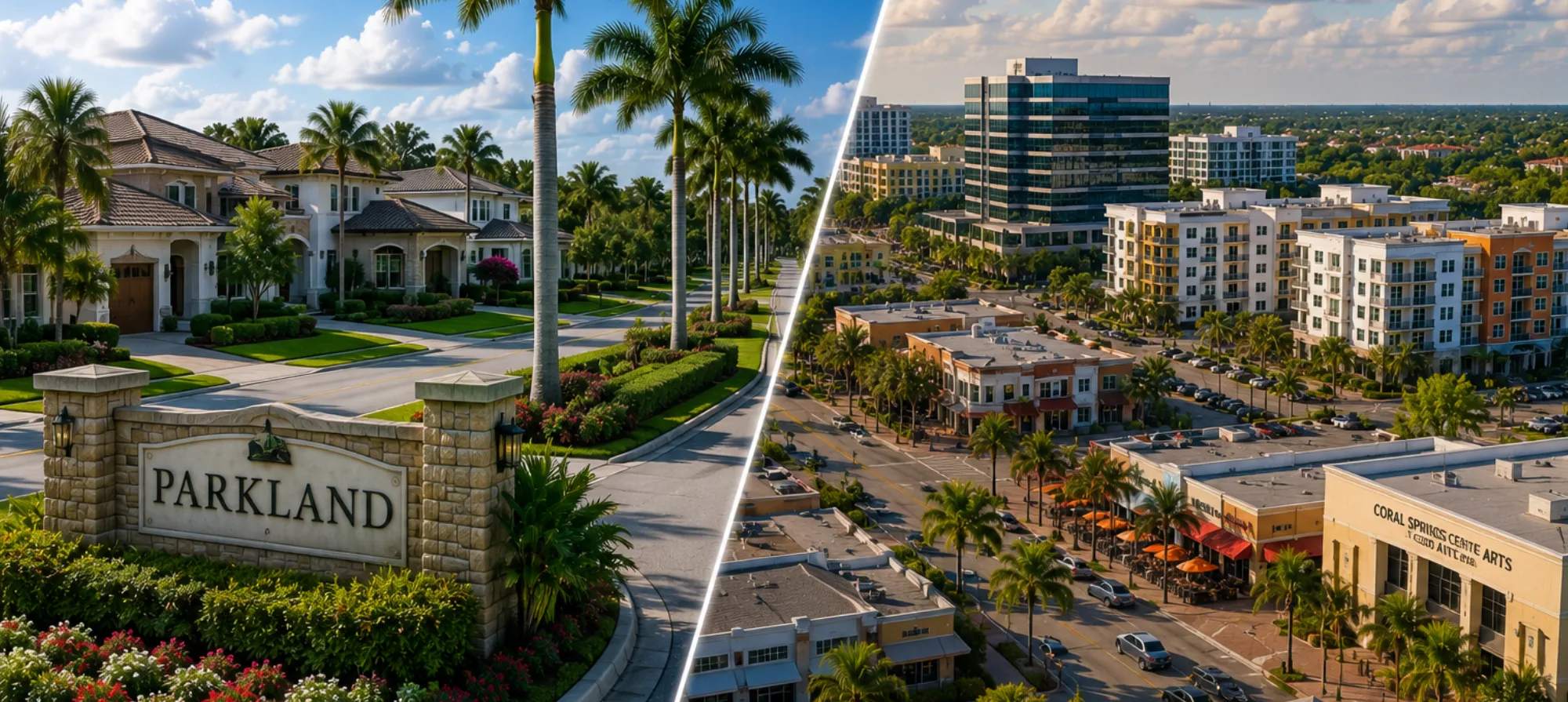
Coral Springs and Parkland share a city line in northwest Broward County, but offer two very different versions of South Florida suburban living. Here is how the two cities actually compare on home prices, lifestyle, schools, and daily life.
Quick verdict: Coral Springs vs Parkland
Choosing between Coral Springs and Parkland comes down to whether you want a larger, diverse, mid-range family suburb with a real downtown and a thriving local job market, or an exclusive, residential-only luxury enclave with $1M-plus entry points and elite-rated schools. Coral Springs is consistently ranked among Florida's most diverse cities, with 18 public schools, a developing downtown, and active code enforcement that keeps the city polished. Parkland is the smaller, quieter, residential-only neighbor with just five public schools, no commercial downtown, and luxury master-planned communities.
Choose Coral Springs if you want broader housing options, more affordable entry points, a downtown for live-work convenience, and a faster, tighter buyer-competitive market. Choose Parkland if you want $1M-plus luxury single-family inventory, a deliberately quiet residential-only environment, and access to elite zoned public schools.
The data shows Parkland's median sale price hit $1,150,000 in May 2026, compared with Coral Springs' $630,000, an 83% premium for Parkland. Both markets are essentially flat year-over-year: Coral Springs up 0.8%, Parkland down 1.3%. Coral Springs is selling faster (43.8 days versus 47.5) and tighter (97.9% sale-to-list versus 96.9%), suggesting strong buyer competition despite the lower price.
Table of contents
- Real estate market
- Cost of living
- Lifestyle and vibe
- Downtown and walkability
- Parks and outdoor recreation
- Dining, nightlife, and culture
- Schools (and the Wiles Road school-zoning hack)
- Commute and transportation
- Quick comparison table
- Who should choose each city
- The case for picking either one
- FAQs
Below are the Coral Springs homes for sale versus the Parkland homes for sale, category by category.
What is the real estate market like in Coral Springs vs Parkland?
Coral Springs is the larger, more diverse market with a broader housing inventory and lower entry prices. Parkland is the smaller, exclusively luxury market with concentrated single-family estates in master-planned communities. The data below comes from MLS Market Summary reports for May 2026.
Coral Springs: Median sale price hit $630,000 in May 2026, up 0.8% over the rolling 12-month period, with an average of $607,241. Active listings: 633, 5.51 months of supply, 97.9% sale-to-list ratio (one of the tightest in Broward County), and 43.8 average days on market. Housing stock is much more varied than Parkland: single-family homes, townhomes, and a substantial number of apartments and leasing communities. About 84% of Coral Springs homes were built between 1970 and 1999, so most inventory is older than Parkland's newer construction, with less reliance on gated HOA designs. Specialty neighborhoods like The Hills offer expansive one-to-three-acre lots that are hard to find in most South Florida suburbs. Updated single-family homes under $500,000 are increasingly rare. See our South Florida market update for more.
Parkland: Median sale price hit $1,150,000 in May 2026, down 1.3% over the rolling 12-month period, with an average of $1,254,582. Active inventory was much smaller at 193 listings, 4.34 months of supply (a tight seller's market), 96.9% sale-to-list ratio, and 47.5 average days on market. Housing stock is almost exclusively gated communities and single-family estates in luxury master-planned developments like Heron Bay, Parkland Golf and Country Club, and Watercrest. Nearly every home for sale in Parkland starts at $1 million or above, and condos and multi-family inventory are essentially nonexistent. The market exploded in development over the last 15 years, so most inventory is newer construction with resort-style amenities.
Bottom line: Coral Springs offers a broader housing variety, lower entry prices, faster sales, and tighter buyer competition. Parkland offers a concentrated inventory of $1M-plus single-family luxury homes and a smaller, more exclusive market.
Trying to decide between Coral Springs and Parkland?
Working with an agent who covers both markets makes the comparison easier. Reach out to The Mastropieri Group, Realtors® or call (954) 710-6504.
How does the cost of living compare in Coral Springs vs Parkland?
Both cities sit in Broward County and share Florida's no-state-income-tax advantage. Property tax rates are identical, but the much higher Parkland median home value translates into much higher tax bills in dollar terms.
Coral Springs: Broward County property tax rates run 1.05% to 1.2%. On the $630,000 median, taxes run about $6,600 to $7,600 annually. Many Coral Springs homes outside The Walk and gated communities have no HOA fees, which can save $200 to $600 a month versus a comparable Parkland property. Day-to-day spending tracks the Broward County average. The city's strict code enforcement keeps property aesthetics consistent.
Parkland: Same 1.05% to 1.2% county rate. On Parkland's $1,150,000 median, taxes run about $12,000 to $14,000 annually, meaningfully higher than in Coral Springs in dollar terms. Most luxury master-planned communities carry HOA fees of $400 to $1,000 a month for resort-style amenities. Restaurants and groceries track below Coral Springs in volume because Parkland has very little commercial density.
Bottom line: Coral Springs is meaningfully cheaper across home prices, taxes in dollars, and many properties' HOA structure. Parkland costs more in every category but offers amenities and exclusivity that come with the price.
What is the lifestyle and vibe in each city?
Coral Springs lives like a large, diverse suburban city with active community life and a real job market. Parkland lives like a small, exclusive residential enclave with no commercial energy.
Coral Springs: About 136,000 residents, a wide demographic mix including young professionals, entrepreneurs, families, and retirees. Coral Springs is consistently ranked among Florida's most diverse cities (Niche.com lists it #3 most diverse suburb in Florida, while HomeSnacks ranks it the most diverse city in the state based on Census HHI data). The community is known for active youth sports, large city parks, and a strong sense of suburban civic identity. Daily life centers on community sports leagues, the Coral Springs Center for the Performing Arts, neighborhood plazas, and the city's developing downtown. The city is famous for incredibly strict code enforcement aimed at maintaining a polished aesthetic. Billboards are banned, commercial signage is strictly limited, and Coral Springs famously hosted the first McDonald's in the country without the iconic Golden Arches sign at all, a fact made famous by an early Trivial Pursuit question.
Parkland: About 40,000 residents, heavily skewing toward families and professionals who want safety, quiet, and a picturesque suburban environment. Niche.com has named Parkland the number one best place to raise a family in Broward County. The city zoned itself for park-like character and did not have traffic lights until the mid-1990s. Daily life centers on the nine city parks, the equestrian center, the farmers market, and master-planned community amenities. Parkland is a place where families plant roots and stay for the long haul.
Bottom line: Coral Springs for a larger, more diverse, civically active suburban experience. Parkland for an intimate, exclusive, residential-only family enclave.
Which has better downtown and walkability?
Coral Springs has a developing true downtown, plus office and commercial density that supports live-work potential. Parkland has essentially no downtown by design.
Coral Springs: The Coral Springs downtown district is actively being built out with upscale shopping, hotels, luxury apartments, restaurants, and a growing creative-class identity. The city houses major corporate employers and office space, meaning residents can realistically live and work within Coral Springs. Walk Score sits in the 40s to 60s in the densest downtown blocks and along University Drive. The combination of downtown plus the Coral Springs Center for the Performing Arts gives the city a culturally active core that most South Florida suburbs lack.
Parkland: Parkland has no traditional walkable downtown. Commercial activity is concentrated in small plazas at the edges of the city, most notably along University Drive and Holmberg Road, with grocery anchors like Publix handling daily essentials. Walk Score sits in the 20s to 30s in most neighborhoods. The city intentionally kept commercial development to a minimum to preserve the park-like character. Because Parkland has almost no office or corporate employment base, most residents commute to Coral Springs, Boca Raton, or Fort Lauderdale for work.
Bottom line: Coral Springs wins on downtown development, live-work potential, and commercial infrastructure. Parkland wins on quiet residential streets, free of commercial traffic.
How do parks and outdoor recreation compare?
Both cities sit inland with no ocean beach access, so outdoor life centers on parks, sports facilities, and Everglades-edge recreation. Parkland is famously park-focused; Coral Springs has a larger sports infrastructure.
Coral Springs: Major recreational anchors include the Coral Springs Sportsplex, Mullins Park, Sportsmen's Park, and the Sandy Ridge Sanctuary. Youth sports are a defining feature of the city, with extensive baseball, soccer, lacrosse, and aquatics programs. Coral Springs is also home to the Coral Springs Aquatic Complex, a regional training facility used by Olympic swimmers. The western edge of the city borders the Everglades, providing wildlife and conservation access.
Parkland: Nine city parks form the backbone of outdoor recreation, including Pine Trails Park, Quigley Park, and Terramar Park. The Parkland Equestrian Center hosts horse boarding, lessons, and weekly events. The city is home to one of Broward County's largest outdoor farmers markets, held weekly at the Equestrian Center. The western edge borders the Everglades, giving residents direct access to airboat tours and wildlife preserves. The nearest ocean beach is about 14 miles east in Pompano Beach or Deerfield Beach.
Bottom line: Coral Springs has organized sports facilities and a deep youth sports culture. Parkland for parks, equestrian access, and a famous farmers' market.
What about dining, nightlife, and culture?
Coral Springs has substantially more dining and cultural infrastructure than Parkland, including a developing downtown with new restaurants and the Coral Springs Center for the Performing Arts. Parkland centers its cultural life on community events.
Coral Springs: The developing downtown district holds a growing lineup of upscale restaurants, a hotel, and luxury apartments. The Coral Springs Center for the Performing Arts hosts touring acts, theater, and concerts. The Coral Springs Museum of Art anchors the visual arts community. The city's restaurant landscape spans casual chains in plazas, independent eateries in the downtown corridor, and ethnic restaurants reflecting the city's diverse population. A growing brewery and craft beverage culture has emerged in recent years. Recent development news includes the $37M Related Ross Coral Springs deal, bringing additional commercial investment to the city.
Parkland: Dining options are limited and concentrated in University Drive plazas, with a mix of casual chains and a few independent restaurants. Cultural life revolves around free monthly community events, the farmers market at the Equestrian Center, and seasonal festivals at Pine Trails Park. Residents typically drive to Coral Springs, Boca Raton, or Fort Lauderdale for serious dining or nightlife.
Bottom line: Coral Springs for downtown dining, performing arts, and a diverse restaurant landscape. Parkland for low-key community events and quiet evenings.
Which city has better schools, and what is the Wiles Road school-zoning hack?
Both cities are top-tier for Broward County public schools. Parkland has five exceptionally well-rated public schools across all grade levels. Coral Springs has 18 public schools with a wide variation in ratings depending on address. But there is a powerful overlap: parts of northern Coral Springs are zoned for Parkland's elite schools.
Parkland: The Broward County School District zones Parkland residents for some of the highest-rated public schools in the county. Heron Heights Elementary has a 10/10 GreatSchools rating. Westglades Middle School and Marjory Stoneman Douglas High School both have 9/10 GreatSchools ratings. Stoneman Douglas is widely noted as the only A-rated district-run high school in the Parkland and Coral Springs area. Private options include the American Heritage School in adjacent Plantation and North Broward Preparatory School in Coconut Creek.
Coral Springs: Coral Springs has 18 public schools spanning the city, with school quality varying significantly by address. Coral Glades High School currently holds a 5/10 GreatSchools rating, and J.P. Taravella High School holds a "B" state grade. Many Coral Springs elementary schools earn 7/10 or higher GreatSchools ratings, but the strongest school zone in Coral Springs is the northern section bordering Parkland, which is zoned for Stoneman Douglas High School (see the Wiles Road note below). Private options include the North Broward Preparatory School in nearby Coconut Creek and the Conservatory Prep Schools.
The Wiles Road school-zoning hack: Buyers frequently target homes in the northern section of Coral Springs (north of Wiles Road) specifically because those neighborhoods are zoned for Parkland's Marjory Stoneman Douglas High School. The strategy gives families access to Parkland's elite zoned public school while shopping in Coral Springs' much more affordable housing market. A buyer can save several hundred thousand dollars versus a comparable Parkland home and still get their child into the same high school. Confirm the exact zoning with the Broward County School District before making an offer, as boundaries can shift.
Bottom line: Parkland has more uniformly high-rated zoned schools across all addresses. Coral Springs has school quality variation by address, but offers the Wiles Road hack for buyers who want Parkland-level schools at Coral Springs prices.
How is the commute and transportation?
Both cities sit in northwest Broward County with similar highway access. Coral Springs has a more central location with stronger employer density; Parkland trades commute access for residential quiet.
Coral Springs: The Sawgrass Expressway runs along the city's western edge with multiple exits. I-95 access is 10 to 15 minutes east. Florida Turnpike access via Sawgrass. Fort Lauderdale-Hollywood International (FLL) is 30 minutes south, Palm Beach International (PBI) is 35 minutes north. The city's downtown corporate corridor along University Drive provides one of the strongest in-city employment bases in northwest Broward, so many residents have short commutes.
Parkland: Sawgrass Expressway runs along the city's western edge. I-95 access is 8 to 12 minutes east via Sample Road or Atlantic Boulevard. Florida Turnpike exit at Coral Ridge Drive. FLL is 30 minutes south, PBI is 30 minutes north. There is no Tri-Rail or Brightline station in Parkland itself, and the nearest Brightline is in Boca Raton, about 14 miles north.
Bottom line: Coral Springs offers in-city employment access and a shorter typical commute. Parkland for highway access with no notable in-city job market.
Coral Springs vs Parkland at a glance
Here is a category-by-category breakdown of how the two cities stack up.
| Category | Coral Springs | Parkland |
|---|---|---|
| Median Sale Price (May 2026) | $630,000 (Lower) | $1,150,000 |
| 12-Month Appreciation | +0.8% | -1.3% |
| Average Days on Market | 43.8 days (Faster) | 47.5 days |
| Sale-to-List Ratio | 97.9% (Tighter) | 96.9% |
| Active Inventory | 633 (More Options) | 193 |
| Housing Variety | Winner (SF + TH + Apts) | Single-Family Only |
| Housing Age | 84% built 1970-1999 | Mostly New (last 15 yrs) |
| Downtown & Live-Work | Winner (Developing Downtown) | Residential Only |
| Diversity | Winner (Among FL's Most Diverse Cities) | Family-Centric |
| Number of Public Schools | 18 Schools | 5 Schools (All Top-Rated) |
| Top-Rated Zoned School | N. Coral Springs zoned for Stoneman Douglas 9/10 | Heron Heights Elem 10/10 |
| Youth Sports Culture | Winner (Sportsplex, Aquatic Complex) | Parks-Focused |
| Equestrian & Farmers Market | Limited | Winner (Equestrian Center) |
Who should choose Coral Springs vs Parkland?
You should choose Coral Springs if...
- You want a broader housing variety, including townhomes, apartments, and single-family homes.
- You value a developing downtown with restaurants, performing arts, and live-work potential.
- You are a young professional, entrepreneur, or first-time buyer drawn to a diverse, mid-range market.
- You want to access Parkland's elite Stoneman Douglas zoning while paying Coral Springs prices (north of Wiles Road).
- You value an active youth sports culture and large recreational infrastructure.
You should choose Parkland if...
- You are buying a $1M-plus luxury single-family home and want concentrated high-end inventory.
- You value a deliberately quiet, residential-only environment without commercial traffic.
- You want resort-style master-planned community amenities like Heron Bay or Parkland Golf and Country Club.
- You want uniformly high-rated zoned public schools across all addresses, not just specific zones.
- You value equestrian access, large city parks, and Broward's biggest outdoor farmers market.
The case for picking either one
Most comparisons skip this: Coral Springs and Parkland share a city line. The northern edge of Coral Springs (past Wiles Road) literally touches Parkland's southern border, and many neighborhoods on the Coral Springs side are zoned for Parkland's elite schools. Buyers do not necessarily have to pick one over the other in a strict sense. Plenty of Coral Springs residents shop, dine, and visit parks in Parkland, and plenty of Parkland residents work, eat downtown, and use sports facilities in Coral Springs. The real question is which city you want to wake up in, and which school zone you want your kids in.
Frequently asked questions
Is Coral Springs or Parkland more expensive?
Parkland is much more expensive. May 2026 MLS data shows a $1,150,000 median in Parkland versus $630,000 in Coral Springs, an 83% premium for Parkland. The gap reflects Parkland's all-single-family luxury inventory versus Coral Springs' broader mix of single-family homes, townhomes, and apartments. Nearly every Parkland home starts at $1 million or above, while Coral Springs has many homes under $600,000.
Which city is appreciating faster, Coral Springs or Parkland?
Both markets are essentially flat year-over-year. Coral Springs' median sale price rose 0.8% in the rolling 12-month period ending May 2026, while Parkland's slipped 1.3%. Neither city is the appreciation winner; the better differentiator is buyer competition, where Coral Springs has the tighter sale-to-list ratio at 97.9% versus 96.9% in Parkland.
Is Coral Springs more diverse than Parkland?
Yes, by a significant margin. Coral Springs is consistently ranked among Florida's most diverse cities, with Niche.com listing it as the #3 most diverse suburb in Florida and HomeSnacks ranking it the most diverse city in the state based on Census household-income-index data. Daily life includes a broad demographic mix of young professionals, entrepreneurs, families, and retirees of varied backgrounds. Parkland is much more demographically concentrated around affluent families. The difference shapes daily life in everything from restaurants to community events to school populations.
Which city has better schools, Coral Springs or Parkland?
Parkland has more uniformly high-rated zoned public schools across all addresses, with Heron Heights Elementary at 10/10 GreatSchools and Marjory Stoneman Douglas High School at 9/10. Stoneman Douglas is the only A-rated district-run high school in the Parkland and Coral Springs area. Coral Springs has 18 public schools spanning the city with significant quality variation by address; Coral Glades High School currently sits at a 5/10 GreatSchools rating. However, the northern section of Coral Springs (north of Wiles Road) is zoned for Parkland's Marjory Stoneman Douglas High School, letting Coral Springs buyers access elite schools at lower home prices. Confirm zoning with the Broward County School District before making an offer.
What is the Wiles Road school-zoning hack?
Homes in the northern section of Coral Springs (north of Wiles Road) are zoned for Parkland's Marjory Stoneman Douglas High School, even though they are technically located in Coral Springs. Buyers who want access to one of Broward County's most elite zoned public schools but cannot afford Parkland's $1M-plus housing market often target these northern Coral Springs neighborhoods specifically. The strategy can save several hundred thousand dollars on the purchase price while keeping access to the same high school.
Which city is a better real estate investment?
Neither city is a strong short-term appreciation play right now, with both essentially flat year-over-year. Coral Springs has the stronger buyer-competition signal (97.9% sale-to-list ratio) and deeper inventory across price points, making it more appealing for rental investors and first-time buyer flips. Parkland has a tighter inventory (4.34 months versus 5.51) and stronger long-term luxury single-family demand, making it more appealing for buy-and-hold luxury investors.
What is the biggest difference between Coral Springs and Parkland?
Housing variety, density, and live-work potential. Coral Springs has about 136,000 residents, 18 public schools, single-family homes from the 1970s to today, townhomes, apartments, a developing downtown, major corporate employers, and a famously diverse demographic mix. Parkland has about 40,000 residents, five public schools, almost exclusively newer luxury single-family estates in gated master-planned communities, no commercial downtown, and a residents-commute-out employment pattern. Coral Springs is built for variety; Parkland is built for exclusivity.
Local help for buyers in Coral Springs and Parkland
Working with an agent who covers both markets makes the decision easier. Whether you are leaning toward a Coral Springs real estate agent or a Parkland real estate agent, reach out to The Mastropieri Group, Realtors®. For luxury buyers, we cover the high-end through our Coral Springs and Parkland luxury realtor practices, with dedicated luxury inventory at Coral Springs luxury homes for sale and Parkland luxury homes for sale. Call (954) 710-6504.
Real estate data sourced from MLS Market Summary reports as of June 26, 2026, reflecting closed sales through May 2026.
Posted by Larry MastropieriEnjoy this blog post? Click here to subscribe for updates

Leave A Comment