
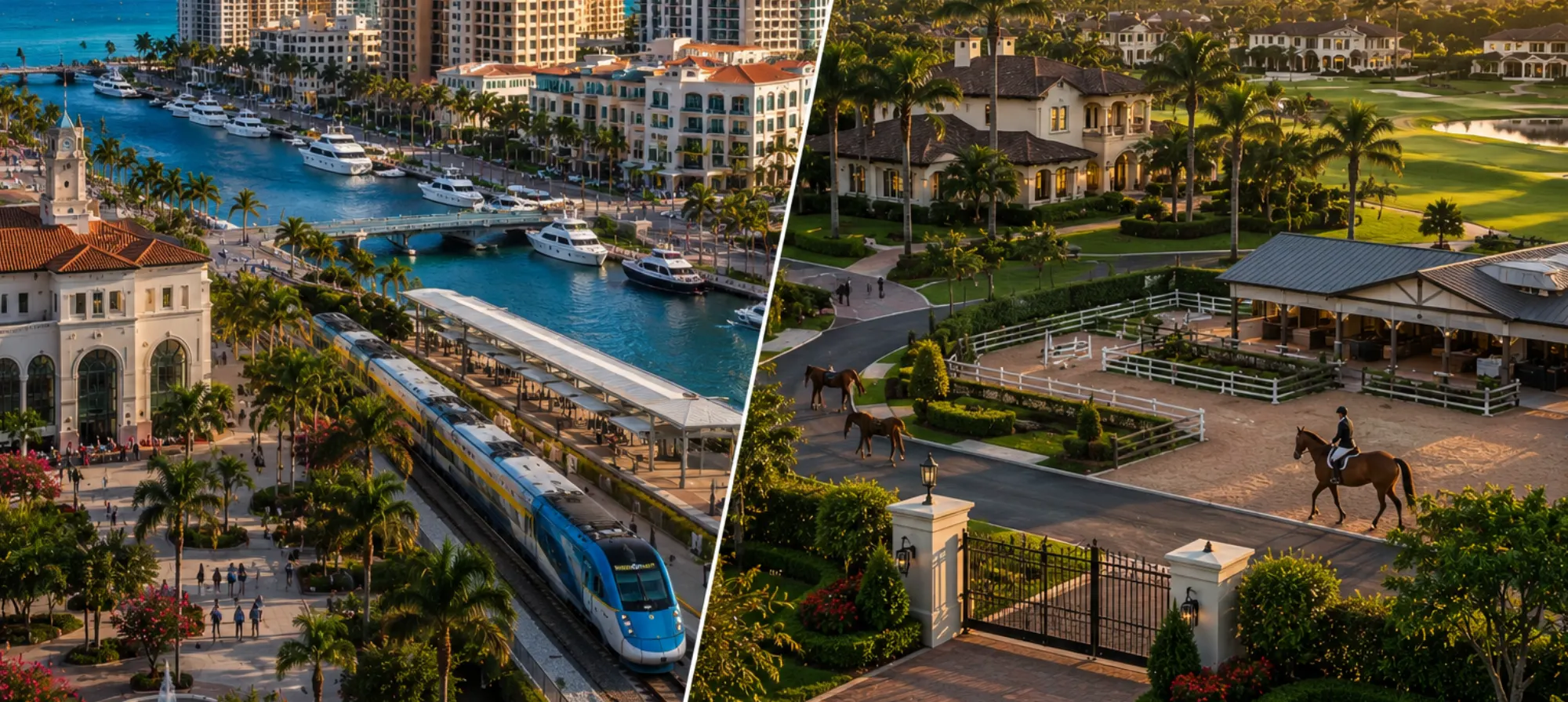
Boca Raton and Wellington are both wealthy, safe South Florida cities, but they offer almost opposite versions of upscale living. Here is how the two stack up on home prices, lifestyle, schools, and daily life.
Quick verdict: Boca Raton vs Wellington
Choosing between Boca Raton and Wellington comes down to whether you want a coastal hub with a real downtown, ocean access, four universities, and a Brightline station, or an exclusive inland equestrian village where 700+ horse farms, a 57-mile bridle trail system, and the largest equestrian competition in the world define daily life. Boca Raton has Mizner Park, miles of public beach, and a diverse demographic. Wellington has the Winter Equestrian Festival, an equestrian overlay zoning district, and luxury master-planned communities ranging from country club homes to $5M-plus horse estates and the Aero Club aviation neighborhood with private hangars and a runway.
Choose Boca Raton if you want coastal living, urban downtown energy, Brightline access, a college-town vibe, and the deepest luxury-condo market in southern Palm Beach County. Choose Wellington if you want privacy, horse country, family-focused suburban quiet, equestrian land, and access to elite zoned public schools.
The MLS data shows a counterintuitive headline: Wellington's median sale price hit $719,000 in May 2026, slightly higher than Boca Raton's $690,000. But Boca is the appreciation play, with the median up 12.75% year-over-year while Wellington's slipped 2.18%. Boca's market is also faster (5.71 months of absorption versus 7.25) and has much deeper inventory across all price points.
Table of contents
- Real estate market
- Cost of living
- Lifestyle and vibe
- Downtown and walkability
- Beaches, equestrian, and outdoor activities
- Dining, nightlife, and culture
- Schools
- Commute and transportation
- Quick comparison table
- Who should choose each city
- The case for picking either one
- FAQs
Below are the Boca Raton homes for sale versus the Wellington homes for sale, category by category.
What is the real estate market like in Boca Raton vs Wellington?
Boca Raton is the larger, more diverse market with deeper inventory across condos, single-family homes, and country club communities. Wellington is the smaller, more specialized market with rare housing types you cannot find in Boca, including multi-acre equestrian estates and an aviation neighborhood with a private runway. The data below comes from the MLS Market Summary reports for May 2026.
Boca Raton: Median sale price hit $690,000 in May 2026, up 12.75% over the rolling 12-month period, with an average sale price of $1,309,687 reflecting Boca's deep luxury market. Active listings: 2,064, 5.71 months of supply, 95.5% sale-to-list ratio, and 73.3 average days on market. Boca is almost completely built-out, which means new product often arrives as zero-lot-line homes squeezed onto small parcels. The market splits clearly: East Boca offers luxury high-rise condos and custom waterfront spec homes (often $4M-plus) with ocean access, including communities like The Sanctuary. Central and West Boca offer gated communities built mostly in the 1980s through the 2000s, as well as newer master-planned communities. Boca also has a high concentration of mandatory-equity country clubs that require large non-refundable buy-ins, which is its own real estate category. There is even a Boca neighborhood called Polo Club, a fun coincidence given Wellington's polo identity.
Wellington: Median sale price hit $719,000 in May 2026, down 2.18% over the rolling 12-month period, with an average sale price of $1,390,456 reflecting heavy luxury weighting. Active listings: 526, 7.25 months of supply, 95.4% sale-to-list ratio, and 79.7 average days on market. Wellington's housing falls into four distinct categories that are hard to mix-and-match with Boca: equestrian estates (often 4 to 5 acres with private barns, running well over $5 million, like the new homes covered in our Joe Farrell Wellington equestrian community announcement), the Aero Club aviation community with a private runway and personal hangars, country club homes, and conventional gated or non-gated suburban neighborhoods. Because Wellington is 18 miles inland from Palm Beach Island, the only waterfront property here is on man-made community lakes, not the ocean. Wellington is also next to new westward expansion in Arden and Westlake, which continues to put pressure on prices.
Bottom line: Boca Raton has the appreciation story (+12.75% YoY), deeper inventory, faster sales, and the only meaningful waterfront option. Wellington has the slightly higher median and the unmatched equestrian housing inventory.
Comparing Boca Raton and Wellington?
Working with an agent who knows both markets makes the comparison clearer. Reach out to The Mastropieri Group, Realtors® Boca Raton office at (561) 544-7000, or the Wellington-area West Palm Beach office at (561) 556-9853.
How does the cost of living compare in Boca Raton vs Wellington?
Both cities sit in Palm Beach County and share Florida's no-state-income-tax advantage. Property tax rates are identical, but the housing types, HOA structures, and country club buy-ins differ in ways that meaningfully change total monthly carrying costs.
Boca Raton: Palm Beach County property tax rates run roughly 1.1% to 1.4% after exemptions. On Boca's $690,000 median, taxes run roughly $7,600 to $9,700 annually. Boca also has the highest concentration of mandatory equity country clubs in southern Palm Beach County, including communities like St. Andrews, Boca West, and others featured in our roundup of top luxury country clubs in Boca Raton to live near. These can require six-figure non-refundable buy-ins on top of annual dues and food minimums, which is specific to the Boca market.
Wellington: Same Palm Beach County tax structure. On Wellington's $719,000 median, taxes run roughly $7,900 to $10,000 annually, very close to Boca in dollar terms. The cost variable that swings the math is housing type: an equestrian estate with stables and pasture has carrying costs (insurance, maintenance, equine staff) that simply do not exist in a Boca condo. Conventional Wellington gated communities carry HOA fees in line with Palm Beach County norms, typically $200 to $700 a month.
Bottom line: Carrying costs run similarly at the median, but the picture diverges sharply at the top of each market. Boca's equity club buy-ins and Wellington's equestrian-property carrying costs are the two cost categories that have no equivalent in the other city.
What is the lifestyle and vibe in each city?
Boca Raton lives like a wealthy coastal city with a real downtown, four universities, and a resort identity. Wellington lives like an exclusive inland equestrian village where the horse industry shapes daily life from January through March.
Boca Raton: About 98,000 residents with a wide demographic mix, from families drawn by the school system to a transient seasonal "snowbird" population to the youthful energy of four universities (Florida Atlantic University, Lynn University, Palm Beach State College, and Everglades University). The city has a resort-style identity anchored by the Boca Raton Resort and its history as a Mizner-era luxury destination. Lifestyle highlights include public beach access, Mizner Park, Royal Palm Place, the Boca Raton Museum of Art, and an active country-club culture. The pace is more urban and outwardly social than Wellington's.
Wellington: About 62,000 residents and the most populous village in Florida, with a heavily family-centric demographic. Wellington's lifestyle parallels Parkland in many ways: a western location, gated communities, and a deliberately secluded family environment away from the urban energy of a coastal downtown. The difference is the horses. Wellington has 700+ horse farms, an equestrian overlay zoning district that legally protects equestrian land use, and the Winter Equestrian Festival, which runs 13 weeks from January through March and brings global elite riders, celebrities, billionaires, and members of European royal families to the village every winter. Even with this seasonal influx, Wellington maintains a suburban-residential character rather than a small-town country one.
Bottom line: Boca Raton for coastal-resort energy and an active downtown lifestyle. Wellington for inland privacy, family quiet, and access to the world's largest equestrian community.
Which has the better downtown and walkability?
Boca Raton has one of the strongest urban downtowns in Palm Beach County. Wellington has no traditional downtown by design.
Boca Raton: The downtown is anchored by Mizner Park (a mixed-use development with shops, restaurants, an amphitheater, and the Boca Raton Museum of Art) and Royal Palm Place (another walkable retail-and-restaurant hub). Walk Score sits in the 60s to 80s in the densest downtown blocks. Downtown has been steadily upgrading with new luxury condo projects, hotels, and restaurants, and multiple new high-rise condos are coming to market. Most weekend dining and nightlife concentrates here. Walkability falls off sharply once you leave the downtown core for the gated communities to the west.
Wellington: No traditional walkable downtown. Commercial activity centers on the Wellington Green mall and a few large plazas along the main thoroughfares, Forest Hill Boulevard and South Shore Boulevard. Walk Score sits in the 20s to 30s in most neighborhoods. Wellington intentionally zoned itself to preserve a park-like, equestrian-focused character with limited commercial intensity. Residents who want a downtown evening typically drive to West Palm Beach (about 20 minutes east) or Palm Beach Island.
Bottom line: Boca Raton wins on downtown infrastructure and walkable amenities. Wellington wins on quiet residential streets and the absence of commercial congestion.
How do the beaches, equestrian, and outdoor activities compare?
This is where the cities diverge most sharply. Boca has the ocean. Wellington has the horses.
Boca Raton: Direct ocean access along five miles of Atlantic coastline, with public beaches at Red Reef Park, Spanish River Park, and South Beach Park. The Boca Raton Inlet gives boaters direct ocean access. Scuba diving, paddleboarding, kayaking on the Intracoastal, and beachfront jogging are part of the daily lifestyle. Gumbo Limbo Nature Center, Florida Atlantic University's research lagoons, and Sugar Sand Park provide additional outdoor recreation. The western edge of Boca borders the Loxahatchee Refuge, giving access to the Everglades ecosystem.
Wellington: No ocean access. The nearest ocean beach is about 22 miles east at Lake Worth Beach or Palm Beach. Wellington compensates with the largest equestrian infrastructure in North America: 57 miles of bridle trails, 700+ horse farms, the International Polo Club Palm Beach (which hosts the US Open Polo Championship), the Winter Equestrian Festival's 250,000+ annual spectators, and the Adequan Global Dressage Festival. The Wellington Aquatics Complex and the Wellington Environmental Preserve at the Marjory Stoneman Douglas Everglades Habitat provide additional outdoor recreation. The western edge borders the Everglades.
Bottom line: Boca Raton for ocean lifestyle, beaches, and boating. Wellington for equestrian sports, polo, and inland nature.
What about dining, nightlife, and culture?
Boca Raton has substantially more dining and nightlife density than Wellington, including a concentrated downtown restaurant corridor and high-end resort dining. Wellington's cultural calendar centers on equestrian events and community festivals.
Boca Raton: Hundreds of restaurants spanning casual chains, independent fine dining, and resort-level options at The Boca Raton (formerly the Boca Raton Resort and Club). Mizner Park concentrates the strongest restaurant cluster. The Boca Raton Museum of Art, the Mizner Park Amphitheater, and the Wick Theatre give the city a strong cultural backbone. The Festival of the Arts Boca runs annually. Nightlife concentrates downtown and along Glades Road.
Wellington: Dining is concentrated in plazas around Wellington Green mall and along Forest Hill Boulevard, with a mix of casual chains, independent restaurants, and a number of highly-rated spots that have grown around the equestrian crowd. The Wellington Amphitheater hosts free movie nights, concerts, and comedy. Cultural life peaks during the Winter Equestrian Festival when international visitors and celebrity attendees fill local restaurants. Residents looking for serious nightlife typically drive to West Palm Beach or Palm Beach.
Bottom line: Boca Raton for restaurant density, downtown nightlife, and cultural infrastructure. Wellington for seasonal equestrian energy and quiet community events.
Which city has better schools?
Both cities sit in the Palm Beach County School District and are well-regarded for public education. Boca Raton has the additional anchor of four universities; Wellington has uniformly A-rated zoned schools across the village.
Boca Raton: Highly rated public schools, including A.D. Henderson University School and Spanish River High School. Elite private prep options include Pine Crest School and Saint Andrew's School. Higher education is concentrated here too: Florida Atlantic University, Lynn University, Palm Beach State College, and Everglades University all have campuses in or immediately around Boca, giving the city a college-town energy that Wellington lacks. The university's presence is also why Boca has a meaningful young-professional and student rental market.
Wellington: Wellington's public schools are competitively rated, with nearly all zoned elementary, middle, and high schools holding an A rating from the Florida Department of Education. The flagship public schools include Wellington High School and Palm Beach Central High School. Zoning consistency means buyers do not have to chase specific addresses to get a top-rated school, a meaningful difference from many South Florida markets. No major university campus is in Wellington itself.
Bottom line: Wellington for uniformly A-rated zoned public schools across the entire village. Boca Raton for elite private prep options and four university campuses that make it a true college town.
How is the commute and transportation?
Boca Raton is one of the most commute-friendly cities in South Florida. Wellington is car-reliant and disconnected from rail.
Boca Raton: Borders I-95 on the east side of the city, with the Florida Turnpike just west. Most importantly, the Brightline high-speed rail station is downtown, giving residents direct one-seat rides to Fort Lauderdale, Aventura, Miami, and Orlando without traffic. Boca is centrally located along the South Florida coastline between West Palm Beach and Fort Lauderdale, which means Palm Beach International (PBI) is 30 minutes north, and Fort Lauderdale-Hollywood International (FLL) is 30 minutes south.
Wellington: 18 miles inland, anchored by the Florida Turnpike on its eastern edge and major surface roads like State Road 7 (Highway 441) and Southern Boulevard. There is no Brightline or Tri-Rail station in Wellington. The nearest Brightline is in West Palm Beach, about 15 miles east. A light rail line connecting Wellington to West Palm Beach has been proposed but is not finalized. PBI is about 20 minutes northeast.
Bottom line: Boca Raton wins on rail access (the Brightline downtown station is a major commuter advantage) and central location. Wellington wins on highway access for buyers heading north or west to PBI or Orlando-bound Turnpike trips.
Boca Raton vs Wellington at a glance
Here is a category-by-category breakdown of how the two cities stack up.
| Category | Boca Raton | Wellington |
|---|---|---|
| Median Sale Price (May 2026) | $690,000 | $719,000 (Higher) |
| 12-Month Appreciation | +12.75% (Winner) | -2.18% |
| Average Days on Market | 73.3 days (Faster) | 79.7 days |
| Absorption Rate | 5.71 months (Tighter) | 7.25 months |
| Active Inventory | 2,064 (Deeper) | 526 |
| Housing Variety | Winner (SF + Condos + Country Clubs + Waterfront) | SF + Equestrian + Aero Club |
| Equestrian Inventory | Minimal | Winner (700+ Horse Farms, $5M+ Estates) |
| Ocean / Waterfront | Winner (5 mi Atlantic Coast) | Inland (Lake Frontage Only) |
| Downtown & Walkability | Winner (Mizner Park, Royal Palm Place) | No Downtown by Design |
| Brightline Access | Winner (Downtown Station) | Nearest 15 mi East |
| Universities & Colleges | Winner (FAU, Lynn + 2 more) | None in Village |
| Population | ~98,000 | ~62,000 |
| Public Schools | A+ Rated + Elite Privates | Winner (Uniformly A-Rated) |
Who should choose Boca Raton vs Wellington?
You should choose Boca Raton if...
- You want direct ocean access, waterfront living, or a beachfront condo.
- You value a real downtown with walkable restaurants, a museum, and nightlife.
- You commute regularly to Miami, Fort Lauderdale, or Orlando and want Brightline access.
- You are a university student, faculty, or want college-town energy.
- You are buying in a mandatory-equity country club with concentrated luxury amenities.
You should choose Wellington if...
- You ride horses, own horses, or work in the equestrian industry.
- You want a $5M-plus equestrian estate with private barns and pasture.
- You are a pilot or private aircraft owner looking at the Aero Club's private runway and hangars.
- You want uniformly A-rated zoned public schools across all addresses.
- You value an inland, family-focused, quiet residential village over coastal urbanism.
The case for picking either one
The two cities are about 30 miles apart, so many buyers end up exploring both. Wellington residents drive to Boca for downtown dining, ocean access, and Brightline trips. Boca residents drive to Wellington for the Winter Equestrian Festival, polo matches, and large-lot rural luxury that does not exist in densely built Boca. The real question is which version of South Florida wealth fits your life: a coastal hub with urban energy, or an inland equestrian village with horse country at the center of it all.
Frequently asked questions
Is Boca Raton or Wellington more expensive?
Wellington's median is actually slightly higher right now. May 2026 MLS data shows Wellington at $719,000 versus Boca Raton at $690,000, a $29,000 gap in Wellington's favor at the median. However, Boca's market is appreciating much faster (+12.75% YoY vs. -2.18% in Wellington), and Boca has a much deeper luxury and ultra-luxury tier, with East Boca waterfront spec homes regularly trading above $4 million. Wellington's top of market is its $5M-plus equestrian estates, which exceed Boca's typical ceiling but represent a much smaller inventory.
Which city is appreciating faster?
Boca Raton is appreciating significantly faster. The median sale price rose 12.75% over the rolling 12-month period ending May 2026, while the average sale price rose 13.75%. Wellington's median slipped 2.18% over the same period. Boca's tighter absorption rate (5.71 months versus 7.25) and faster days on market (73.3 versus 79.7) also point to stronger buyer demand. Buyers prioritizing appreciation should lean Boca; buyers prioritizing value at the top of a flat market should lean Wellington.
What makes Wellington the "equestrian capital of the world"?
Wellington has more than 700 horse farms, a 57-mile bridle trail system, and the equestrian overlay zoning district that legally protects equestrian land use across large parts of the village. The Winter Equestrian Festival runs 13 weeks from January through March and is the largest and longest-running equestrian competition in the world, drawing more than 250,000 spectators and competitors from 40+ countries. The festival alone contributes more than $538 million annually to Palm Beach County's economy. No other municipality in North America concentrates this much equestrian infrastructure in one place.
Which city has better schools, Boca Raton or Wellington?
Both are strong. Wellington has more uniformly A-rated zoned public schools across the entire village, so buyers do not need to chase a specific address to get a top-rated school. Boca Raton has top public schools at addresses zoned for Spanish River High School and A.D. Henderson University School, plus elite private prep options like Pine Crest School and Saint Andrew's School. Boca also has four university campuses (Florida Atlantic University, Lynn University, Palm Beach State College, and Everglades University) that give the city a college-town identity Wellington lacks.
Which is a better real estate investment, Boca Raton or Wellington?
Boca Raton has the stronger short-term appreciation case (+12.75% YoY median growth, +13.75% average sale price growth, tighter inventory). Wellington offers a more specialized long-term case: the equestrian market faces structural demand constraints (private barns, equestrian zoning, proximity to WEF) that support long-term pricing for $5M-plus horse estates. For buyers focused on rental yield or short-term appreciation, Boca is the cleaner play. For buyers focused on equestrian property as a generational hold, Wellington is the only Florida market that makes sense.
Can you live in Wellington without a horse?
Yes. Most Wellington residents do not own horses. The village's conventional gated and non-gated suburban neighborhoods house most of the 62,000-plus residents, and the equestrian industry mostly concentrates in the southeastern part of the village near Wellington International and the polo grounds. Many buyers move to Wellington for the schools, the family-focused, quiet atmosphere, and suburban privacy, with no involvement in the horse community at all.
What is the biggest difference between Boca Raton and Wellington?
Location and identity. Boca Raton is a coastal hub of about 98,000 residents with five miles of Atlantic coastline, a downtown anchored by Mizner Park and Royal Palm Place, a Brightline station, four university campuses, and deep luxury inventory split between waterfront condos and gated communities. Wellington is an inland village of about 62,000 residents, 18 miles from the Atlantic Ocean, with no traditional downtown, no rail access, no major university, but the densest equestrian infrastructure in North America. Boca is built around the ocean and the downtown. Wellington is built around the horse.
Local help for buyers in Boca Raton and Wellington
Working with an agent who covers both markets makes the comparison easier. Whether you are leaning toward a Boca Raton real estate agent or a Wellington real estate agent, reach out to The Mastropieri Group, Realtors® Boca Raton office at 150 E Palmetto Park Rd Ste 800, Boca Raton, FL 33432, or the West Palm Beach office that covers Wellington at 700 Rosemary Ave #204, West Palm Beach, FL 33401. For luxury buyers, we cover the high end through our Boca Raton and Wellington luxury realtor practices, with dedicated luxury inventory at Boca Raton luxury homes for sale and Wellington luxury homes for sale. Call (561) 544-7000 (Boca) or (561) 556-9853 (West Palm Beach).
Real estate data sourced from MLS Market Summary reports as of June 30, 2026, reflecting closed sales through May 2026.
Posted by Larry MastropieriEnjoy this blog post? Click here to subscribe for updates

Leave A Comment