
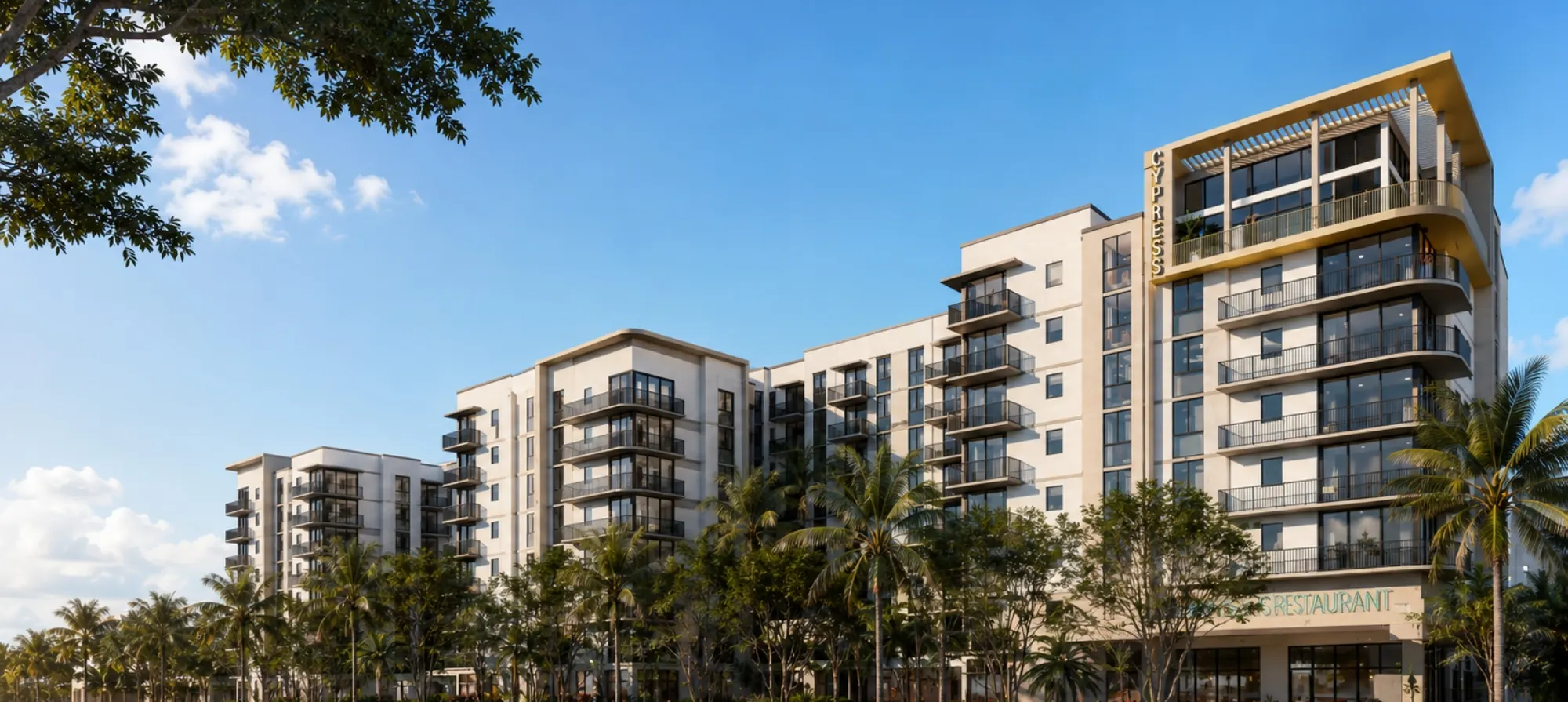
The 340-unit Fort Lauderdale apartment project is the developer's third Broward build in a row, each funded by a different public incentive. This time the tool is a county property-tax rebate, in exchange for 136 workforce units in Ft. Lauderdale.
Key Takeaways
- Affiliated Development is seeking an $8.83 million Broward County property-tax reimbursement to help build The Cypress, an eight-story, 340-unit apartment tower in Fort Lauderdale.
- Of the 340 units, 136 would be workforce housing for households earning 100% to 120% of the area median income, which is around $89,000 in Broward.
- It is the developer's third Broward project, funded by a third, different public incentive, and the request has been filed but is not yet approved.
You may wonder how many ways can Florida help a developer build one apartment complex? Well, Affiliated Development surely has all the answers. According to Florida YIMBY, the Fort Lauderdale firm has filed for an $8.83 million tax incentive to help build The Cypress, an eight-story, 340-unit apartment building at 400 Corporate Drive. It would be the company's third Broward project in a row, potentially funded by a third different public tool.
What is The Cypress, and what is Affiliated asking for?
The Cypress would rise eight stories with 340 apartments at 400 Corporate Drive, in Fort Lauderdale's Cypress Creek area near I-95. The unit mix is 204 market-rate apartments and 136 workforce units for households earning 100% to 120% of the area median income, which is about $89,100 in Broward County. Units will have one to three bedrooms, and the building comes with a pool, clubroom, fitness center, and some retail. It would share a parking garage with the neighboring Westin Fort Lauderdale hotel. Affiliated has the 3.76-acre site under contract, designed by its in-house architect, with construction possibly starting in the second quarter of 2027.
Affiliated is asking for an $8.83 million tax break through Broward County's Affordable-Workforce Housing Ad Valorem Tax Reimbursement Incentive. This program refunds a portion of a project's property taxes when it includes income-restricted housing. In plain terms, the developer builds the workforce units, and the county rebates some of the property tax as the reward. The request has been filed but is not yet approved.
How does one developer keep getting public funding?
This is the story worth watching. Affiliated keeps building workforce housing across Broward, but funds each project with a different public mechanism. The Cove leaned on the Live Local Act, the state law that lets projects skip local zoning limits in exchange for affordable units, paired with a $74 million loan. The Jax used roughly $6 million in direct public incentives. And The Cypress now seeks an $8.8 million property-tax reimbursement. Three projects, three tools, a case study in how many separate levers now exist to make workforce housing pencil out. On The Era in Fort Lauderdale alone, Affiliated stacked both a city and a county property-tax reimbursement on top of an $80 million loan.
The company is candid that these deals do not happen on their own. As Larry Mastropieri explained on the Discover South Florida Podcast: "This helps things pencil out because construction costs are expensive. Land costs are expensive. This stuff isn't really viable if the taxpayers, us, don't incentivize this." As Larry put it more bluntly: "Without these incentives, it usually doesn't get done." In effect, Affiliated has turned incentive-stacking into a repeatable business model, pulling from a different public pot each time.
Renting, buying, or investing in Fort Lauderdale's apartment boom? Knowing what is in the pipeline helps you time it right. Talk to a real estate agent in Fort Lauderdale who tracks new development. Reach out to The Mastropieri Group, Realtors® or call (954) 833-1468.
Is "workforce housing" actually affordable?
Here is the honest question the pattern raises. The 136 workforce units target households earning 100% to 120% of area median income, and with Broward's median around $89,100, a qualifying renter can still earn six figures. So this is middle-income housing, aimed at the teachers, nurses, and service workers priced out of market-rate rents, rather than deeply affordable or low-income housing.
As Larry noted, someone from a cheaper part of the country might look at these "affordable" rents and find them expensive, and they would have a point. But in a market where market-rate rents have run far ahead of wages, workforce units at a real discount still help a squeezed middle.
Watch More on This Topic: Watch this segment | Full Episode | Last week's recap
Frequently Asked Questions
What is The Cypress in Fort Lauderdale?
The Cypress is a proposed eight-story, 340-unit apartment building at 400 Corporate Drive in Fort Lauderdale's Cypress Creek area, developed by Affiliated Development. It would include 204 market-rate units and 136 workforce housing units, and it would share a parking garage with the adjacent Westin hotel. The project is proposed, not yet approved.
What is the $8.8 million tax break Affiliated is seeking?
Affiliated has requested about $8.83 million through Broward County's Affordable-Workforce Housing Ad Valorem Tax Reimbursement Incentive. The program refunds a portion of a project's property taxes over time in exchange for including income-restricted workforce housing, which helps the numbers work for the developer.
How many affordable units will The Cypress have?
The plan sets aside 136 of the 340 units as workforce housing for households earning 100% to 120% of the area median income, with the other 204 units renting at market rate. In Broward County, the area median income is currently about $89,100.
What is the Live Local Act?
The Live Local Act is a 2023 Florida law that gives developers zoning flexibility and tax benefits in exchange for including a share of affordable or workforce housing. It lets qualifying projects bypass some local zoning, height, and density limits, and it is one of several tools developers use to fund this kind of housing.
Is workforce housing the same as low-income housing?
No. Workforce housing targets middle-income earners, in this case households making 100% to 120% of the area median income, rather than the lowest-income households that traditional affordable housing serves. It is meant for people like teachers, nurses, and service workers who earn too much for low-income programs but are still priced out of market-rate rent.
Local help for Fort Lauderdale renters, buyers, and investors
Whether you are renting near a new project, buying, or weighing an investment as Fort Lauderdale's apartment pipeline grows, it helps to work with a team that follows local development closely. Reach out to The Mastropieri Group, Realtors® in Fort Lauderdale, or call (954) 833-1468 for practical, hands-on guidance across South Florida.





Enjoy this blog post? Click here to subscribe for updates

Leave A Comment