
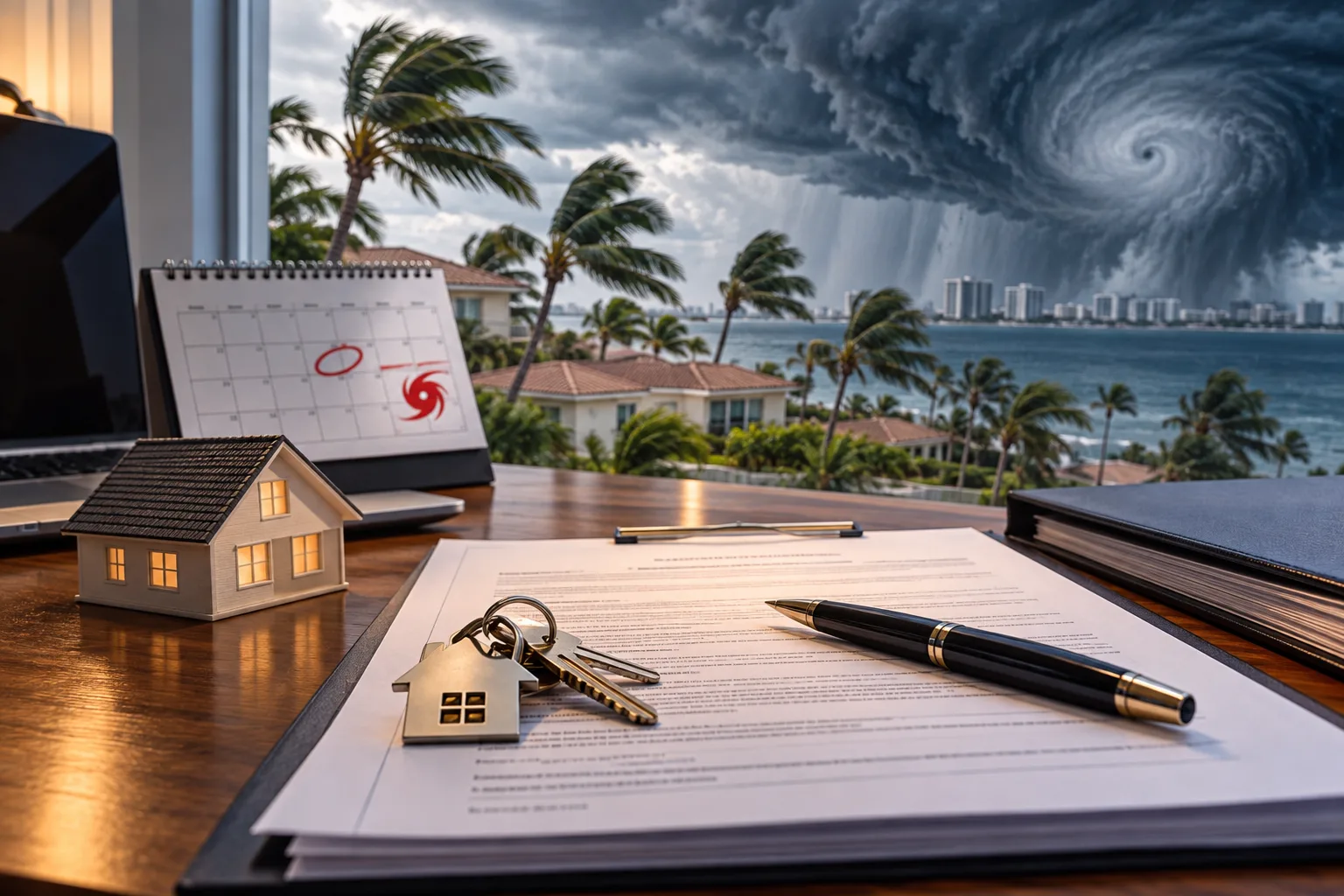
Your closing likely moves instead of dying. Standard G extends every deadline while a storm disrupts performance, insurance binding, or approvals essential to closing. Either party may cancel if delays exceed 30 days. Damage triggers Standard M, where the seller covers restoration up to 1.5% of the purchase price. Above that, you choose between a credit and your deposit back.
Two Contract Provisions Carry the Weight
Florida contracts anticipate hurricanes directly, which surprises people who assume a storm creates legal chaos. On the Discover South Florida Podcast, Larry Mastropieri pointed straight at the language.
"There's a section in the contract that states force majeure, which basically changes how everything happens in the contract."
Two separate provisions split the work between them. Standard G governs timing, deciding when deadlines move and when either side may walk. Standard M governs money, deciding who pays when wind or water actually damages the property.
Standard G Extends the Clock
The clause suspends performance obligations while the event continues. Its definition reaches hurricanes, floods, fire, acts of God, unusual transportation delays, wars, acts of terrorism, and other causes outside either party's reasonable control.
One phrase matters more than the rest for South Florida transactions. The provision covers disruption to the availability of services, insurance, or required approvals essential to closing, which captures far more than physical damage.
- All time periods, including the closing date, extend while the disruption continues.
- The extension generally runs up to seven days after the event stops preventing performance.
- Delays pushing past 30 days beyond the original closing date let either party cancel.
- Cancellation under that provision returns the buyer's deposit.
Insurance Binding Is the Usual Trigger
Carriers stop writing new policies once a watch or warning covers the area, and no lender funds an uninsured purchase. Larry walks through exactly how that chain breaks.
"If you have a loan that you're getting for this property, and the insurance company stops binding policies, and thus the lender won't close, well, you have time to go solve this. The contract just gets extended."
Note what this means for cash buyers. Nobody requires them to carry insurance, so a binding moratorium never blocks their closing. Cash deals therefore proceed while financed ones wait.
Storm in the forecast and a closing date on the calendar? Talk to a real estate agent near Boca Raton who knows which deadlines move automatically and which ones still need a signed extension. Reach out to The Mastropieri Group or call (561) 544-7000.
Should You Try to Close Before Landfall?
Practice diverges from theory in the days before a storm arrives, and the two sides usually want opposite things. Larry describes the seller's instinct in that moment.
"In a perfect world, seller wants to get it done and get out. Okay buyer, let's just close. It's not here yet, we can close today. Hurricane will be here in three days."
An early closing works only when every piece aligns.
"Assuming the insurance company's insuring and there's no loan and all these things, you're okay."
Buyers rarely cooperate, and Larry is blunt about it.
"They'll typically claim it though. They'll say, hey listen, can't do this until after."
That refusal makes perfect sense. A buyer who closes two days before landfall owns the damage, while a buyer who waits leaves that exposure with the seller. Sellers across Palm Beach County push hard for early closings precisely because the risk transfers at the closing table.
Who Pays if the Storm Damages the Property?
Damage occurring after the effective date but before closing becomes a casualty loss. The contract resolves it with a percentage instead of a negotiation.
Larry frames the seller's position in plain terms.
"You have some optionality in the contract to keep the contract alive. You just have to deliver the product that the buyer had agreed to buy, which might be very different after the hurricane."
The mechanics run in two directions from a single threshold.
- Restoration costing 1.5% of the purchase price or less becomes the seller's obligation, and closing proceeds.
- Work unfinished by closing requires escrowing 125% of the estimated completion cost, capped at that 1.5%.
- Restoration exceeding 1.5% hands the buyer a choice between two outcomes.
- That buyer may take the property as-is along with the 1.5%, or take a deposit refund and walk.
- Tree damage carries a narrower obligation, limited to the cost of pruning or removal.
What 1.5% Looks Like in Dollars
The percentage sounds abstract until you apply it to real South Florida prices, whether in West Palm Beach or further north.
- A $400,000 condo produces a $6,000 seller obligation.
- A $750,000 home produces $11,250.
- A $1.5 million property produces $22,500.
- A $3 million waterfront home produces $45,000.
Hurricane damage clears those numbers with ease. A single roof section or a flooded ground floor pushes past the threshold on most properties. The decision then belongs to the buyer, not the seller.
Nobody Specifies Who Measures the Damage
Here sits the gap that generates most disputes. The contract establishes the 1.5% line without naming who determines whether repairs fall above or below it.
Both sides therefore arrive with their own numbers, since a seller wants an estimate under the threshold and a buyer wants one above it. Get licensed contractor estimates immediately and photograph everything. Owners in Delray Beach and Boca Raton should expect the other side to do exactly the same.
Reality Runs on Negotiation
Larry's broader point is that contract language sets the boundaries while people settle the outcome.
"It becomes this negotiation. It's pretty simple. We can fight all day about the terms and the contract. We do this all the time with transactions."
His estimate of how these end carries weight given his volume.
"There's a lot of deals that get saved. 90% of them get saved, maybe even more. 95% of them get saved by just working things out as a team, negotiating, understanding what the rules of the contract say."
He also explains why a high-volume agent sees this differently than counsel does.
"The attorneys don't get the average deal on their table. They get the ones that went really bad. The ones that we couldn't save."
Attorneys remain essential when a dispute hardens, though most storm-affected contracts never reach that point. Buyers and sellers in Broward County typically land on a credit, a short extension, or a revised repair scope.
Before the Storm Arrives
- Bind insurance the moment your inspection period allows, well ahead of any forecast.
- Ask your lender whether a post-storm reinspection precedes funding.
- Photograph the entire property, inside and out, with timestamps intact.
- Confirm with title whether early closing remains possible on your timeline.
- Agree in writing on how you will communicate once power and internet fail.
- Locate the seller's current policy details in case a transfer becomes relevant.
- Ask a Palm Beach Gardens real estate agent about local carrier behavior if you are buying north.
After the Storm Passes
- Document damage immediately with photos, video, and dated notes.
- Obtain written repair estimates from licensed contractors, not verbal figures.
- Calculate 1.5% of your purchase price before discussing anything.
- Reconfirm insurance availability, since carriers resume binding after the threat clears.
- Expect a lender reinspection when the property sits in a declared disaster area.
- Put any agreed extension or credit in a signed addendum, never a text message.
This page describes general practice under Florida residential contracts. Your specific agreement governs, and an attorney should review any casualty dispute.
Storms Delay Closings Far More Often Than They Kill Them
The contract already answers most of what a hurricane throws at a transaction, and panic does more damage than the provisions themselves. We know which deadlines move on their own, what still needs paperwork, and where the 1.5% line falls on your price. That clarity keeps a deal alive while everyone else assumes it died. Reach out to The Mastropieri Group, Realtors® at (561) 544-7000 and tell us your closing date and we will tell you what the storm actually changes.