
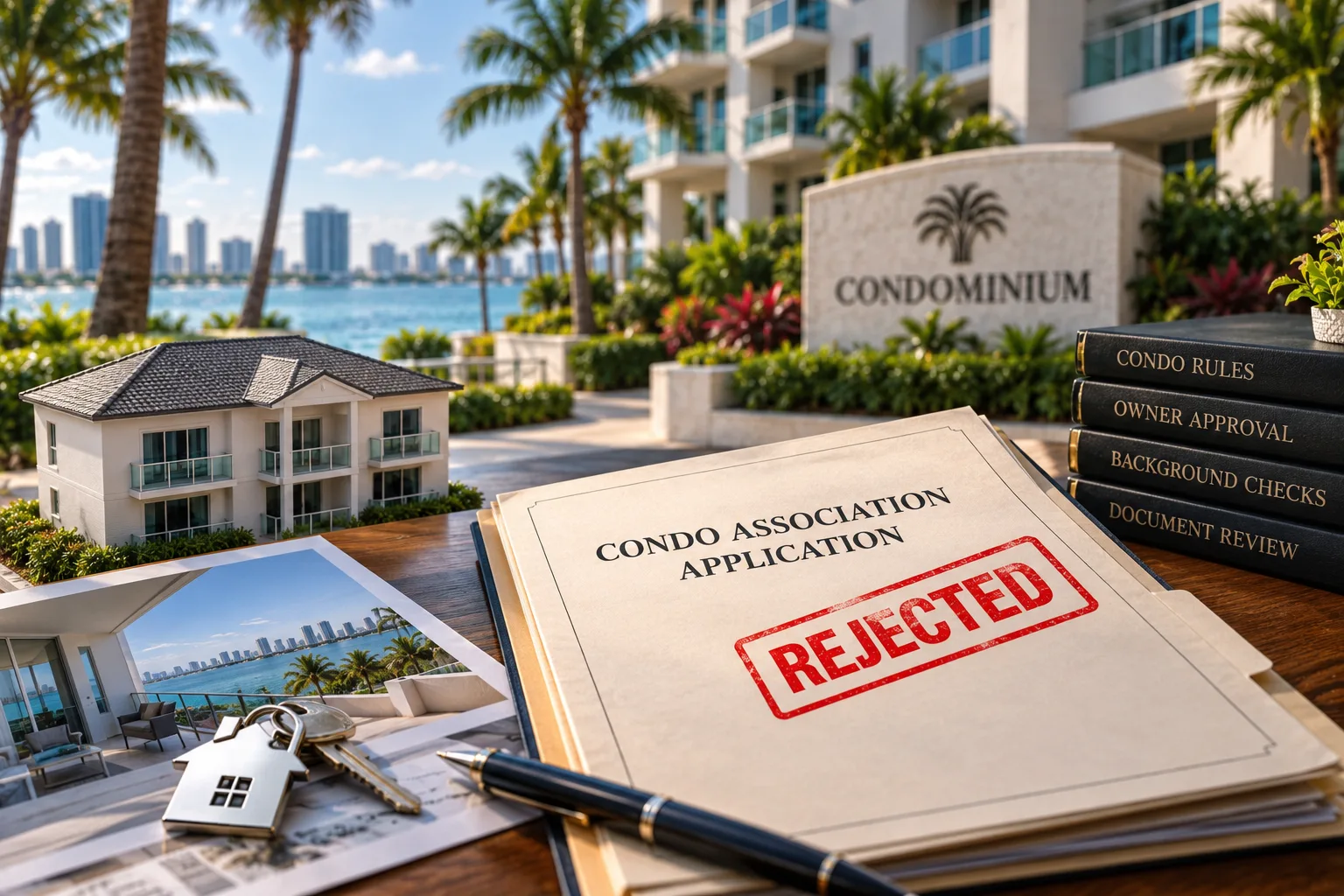
Yes, when the declaration grants that power. Florida boards may screen buyers on credit, income, and background, though denials must trace to written criteria and comply with fair housing law. Verify every requirement before going under contract. Confirm which credit bureau the association uses, and tell your buyer to change nothing financially until approval lands.
Where the Approval Power Comes From
No statewide law hands associations a veto over your buyer. That power has to appear in the declaration of condominium, the articles, or the bylaws. Documents silent on the subject leave a board with no right to reject anyone.
On the Discover South Florida Podcast, Larry Mastropieri framed the variability honestly.
"A condo association can in some cases, not all cases, reject your buyer. It depends on the rules, regs, the covenants, the condo declaration, all the documents associated with the condo building."
Chapter 718 governs Florida condominiums and limits what boards may charge for the privilege, which matters in dense condo markets like Boca Raton. Section 718.112(2)(k) caps a transfer or approval fee at $150 per applicant. Spouses count as a single person, as do a parent and dependent child. The governing documents must expressly authorize the charge.
How Does a Credit Requirement Kill a Deal?
Larry's clearest example involved a requirement everyone knew about in advance.
"Buyer didn't hit the credit score requirement for the building. We all knew, my agent and the buyer and the seller, that there was a requirement. This wasn't a surprise."
The documentation looked fine until the association ran its own report.
"The buyer's lender and the buyer had documents showing that they were 760, and then they went and ran the credit score and they were using a different credit reporting agency which reported it lower."
Then the Buyer Helped
What happened next turned a near miss into a denial, and it came from good intentions.
"This buyer supposedly thought it was a good idea to go pay off her credit cards and do all these things, strategically. She just went ahead and started doing that without having a conversation with my agent or the lender."
A paydown can drop a score temporarily, particularly when accounts close or the credit mix shifts. Larry describes the outcome plainly enough.
"Unfortunately, it actually did the opposite. It tanked the credit score for her, and it was on the credit score that was with a credit bureau that typically reports lower. They declined her."
The Coaching That Prevents It
Larry's instruction to his agent is specific enough to use verbatim.
"Before the buyer goes through this whole process and you get under contract, you need to go talk to the lender and say, what are the three credit agency scores? Do they qualify? When did you run them?"
The second conversation matters every bit as much.
"Now go talk to the buyer and say, do not do anything. I don't want you to touch these credit cards. I don't want you to pay off this student debt because you think it's helpful. If the lender needs you to do that, do it after we get approved by the association."
Note who shares the blame in his telling, since that is the useful part for sellers.
"The listing agent could have done a better job, the buyer's agent could have done a better job, the lender could have done a better job in coaching everyone involved."
About to list a condo in a building with a tough board? Talk to a real estate agent near Boca Raton who reads the screening criteria before accepting an offer and confirms your buyer clears them. Reach out to The Mastropieri Group or call (561) 544-7000.
Your Rights After a Credit Denial
Federal law gives a declined applicant more leverage than most people use. The Fair Credit Reporting Act requires written authorization before an association pulls a consumer file. Any adverse action resting on that file then triggers disclosure obligations.
- The association must identify which consumer reporting agency supplied the information.
- The notice must inform the applicant of the right to dispute inaccurate entries.
- Applicants may obtain a free copy of the report that produced the denial.
- Scores from Equifax, Experian, and TransUnion legitimately differ, which a dispute or second report can document.
Ask for that notice in writing every time. A denial that cannot identify its source invites a challenge. Buyers in West Palm Beach buildings sometimes fix the problem with a corrected report instead of a lawsuit.
What Separates Lawful Screening From Pretext?
Boards may apply financial standards. Those criteria cannot shift from one applicant to the next, and no board may deny on a protected basis.
Two statutes govern here. The federal Fair Housing Act and Florida's version at Section 760.23 both bar housing discrimination. Protected classes include race, color, national origin, religion, sex, family status, and disability. Courts also continue to hear disparate impact claims, so a neutral-sounding rule can still violate the law through its effect.
Legitimate screening tends to share certain traits.
- Written criteria that exist in the governing documents before any application arrives.
- Identical standards applied to every applicant without exception.
- A stated reason that traces directly to those criteria.
- Individualized review in place of blanket exclusions.
- Documented decisions instead of verbal refusals.
When a Denial Looks Like Something Else
Larry described a case he remains certain about, involving a young Latino buyer and a board composed largely of absentee members.
"They declined a Latin kid that we were putting in a property. He was buying this condo, and the board declined."
No reason accompanied the decision, which is itself a signal.
"It was declined. And it's like, well, why?"
The buyer chose to push back through counsel, and the response arrived quickly.
"He contacted one of our attorneys. One of our attorneys sent one email. All of a sudden, the emails worked, and he got approved two days later."
What Recourse Looks Like
A single attorney letter resolves many of these situations, since boards and their managers understand the exposure. Owners across Palm Beach County report the same pattern. Owners and buyers hold several options beyond that.
- A written demand for the specific reason behind the denial.
- A complaint with HUD, generally filed within one year of the alleged violation.
- A complaint with the Florida Commission on Human Relations.
- Private legal action, which can include damages and attorney fees.
Broward Requires a Stated Reason
Local law supplies leverage that state law does not. Broward County requires condominiums, homeowner associations, and cooperatives to tell applicants why they denied an application. Silence itself signals trouble. A board unwilling to put reasoning in writing has usually failed to tie the decision to its own documents. Request that explanation immediately.
Unlimited Discretion Has a Price
Florida courts have refused to enforce approval rights that amount to absolute veto power. An association may withhold consent for any reason only when it carries a matching obligation. That duty means buying the unit or producing a substitute buyer at fair market value.
Absent that obligation, unchecked authority can fail as an unreasonable restraint on an owner's ability to sell. One rejected buyer recovered nearly $200,000 in damages even where the association exercised a right of first refusal. Board members can face personal liability alongside the association itself.
Larry raises the practical cost that keeps many people quiet, and it deserves weight.
"You're looking for a place to live. You don't have time to deal with this and people you don't want to deal with."
Approval also means actually moving in. A buyer who threatens litigation before closing may spend years beside those same board members. Some clients decide that alone is reason enough to find another building.
Rules Can Change After Your Buyer Closes
Approval is not the last hurdle, and Larry's third example shows how far the consequences reach. A client bought a high-value condo planning a renovation worth about $2 million, having confirmed the building allowed work during season.
"A month after he started work, they changed the rules on the condo community that said you can't do work during season."
The delay carried a serious price, since he was holding the property while renting elsewhere at roughly $30,000 a month. An attorney himself, he fought back and won decisively.
"He sues the board, and by the time he's done he removed everybody."
Victory created its own problem in a very small building.
"You removed like seven people. You're at war with 30% of the people that are in the building already."
He sold the place anyway. Larry summarizes the ending without any drama.
"Two and a half years later he's like, I'm done with condo buildings and I'm buying a house. The community isn't the community we had hoped it would be for us."
Buyers planning renovations in Palm Beach Gardens or similar markets should confirm construction rules in writing and ask whether amendments are pending.
Protecting the Sale Before You Accept an Offer
- Pull the declaration and bylaws to confirm whether approval authority exists.
- Request the written screening criteria, including any credit or income thresholds.
- Ask the buyer's lender for scores from all three bureaus, with dates.
- Confirm which reporting agency the association's screening vendor uses.
- Instruct the buyer in writing to make no financial changes before approval.
- Submit a complete application package, since missing items restart the review clock.
- Check for a right of first refusal, which can delay or redirect the sale.
- Build the approval window into your contract timeline realistically.
Review periods commonly run ten to thirty days depending on the documents. Sellers in Delray Beach and Broward County lose weeks when an incomplete package resets that clock.
This page covers general concepts and is not legal advice. A Florida attorney should review any denial, discrimination concern, or governing document question.
Clear the Board Before You Clear the Contract
Nearly every association denial we have seen was visible in advance, sitting in a document nobody opened or a credit score left unverified. We pull the screening criteria before you accept an offer and confirm the buyer actually clears them. Both sides then get coached on what not to touch during the review window. That work costs nothing and saves months. Reach out to The Mastropieri Group, Realtors® at (561) 544-7000 and name the building and we will tell you what its board actually requires.